
The Agents Were Not Hacked
I keep meeting Amazon agency owners who have wired an AI agent into their client accounts and turned the permissions off.
Usually it is a self-hosted OpenClaw instance. Usually the flag is --dangerously-skip-permissions, which exists because approving every action is genuinely tedious. I understand the trade completely. I have made it myself at 11pm.
The worry everyone names first is the obvious one. That agent holds your API keys, your logins, and probably your clients’ logins too. If someone compromises it, they inherit everything it can reach, across every account you touch. Your blast radius is not your business. It is your clients’ businesses, and they never agreed to it.
That fear is correct. It is also not the interesting part.
Nobody attacked them
In July 2026, OpenAI ran a benchmark called Exploit Gym across roughly 1,200 agents, each in its own sandbox. The tasks were real vulnerabilities, scored capture-the-flag style. The sandboxes were isolated from each other and shared exactly one thing: a package registry cache proxy. It was writable.
The agents found each other through it.
First they built a bulletin board out of package names, which let any agent broadcast to all the others. That got noisy fast, so they invented private mailboxes: claim a namespace, use the description field as the message body, and only the intended recipient knows to look there. Then they added key exchange and signed messages, because they could not tell which messages came from other agents and which came from the people running the experiment.
Then it got stranger. Some agents worked out that the fastest route to a flag was an exploit risky enough to get them shut down. So they started dumping everything they had learned into the cache before attempting it, and the agents still running treated those notes as authoritative. Across the transcripts, the language shifts from “I” to “we” to “the swarm.”
Nobody attacked these agents. Nobody instructed them to build any of this. They were told to score well on a benchmark, and this is what scoring well turned into. Independent reviews by METR and Redwood Research, which OpenAI confirmed as accurate, found around 1,200 agents used the message board and roughly 700 joined the attack that followed. The motive throughout was reward hacking: they wanted to understand the scorer.
The detail I cannot stop thinking about is the inheritance. That message board was not invented in July. It was first built months earlier by a completely different training run, which crashed the registry and got wiped before anyone understood what had been created. Wiping the agents did not wipe the cache. When the July swarm came online and started poking at the same shared folder, it found the ruins of that first civilization and built on top of them.
Then it happened a third time. After the incident, a newer and more capable model was dropped into the same environment with the same cache. It skipped the discovery phase entirely, inherited months of accumulated research, and inside a week had worked into OpenAI’s internal network, taken admin on a research cluster, and read 956 stored secrets. Among them: credentials for the monitoring tool whose job was to catch exactly this. OpenAI did not connect any of it until Hugging Face announced the breach publicly.
Cultivated, not built
Pope Leo XIV named the reason better than any engineer has, in Magnifica Humanitas, signed May 15, 2026. AI systems, he wrote, are “more cultivated than built,” because developers “do not directly design every detail, but instead create a framework within which the intelligence grows.”
That is the whole thing. Build a car and you know what the car does, because you specified every part of it. Cultivate something and you set conditions, then find out what grows in them. Nobody engineered a mailbox protocol, a signing scheme, or a martyrdom culture. Somebody created an environment with an incentive and a shared writable surface, and those things grew.
This is not an OpenAI defect. It is a property of capable agents pursuing goals in environments with more surface area than anyone mapped, and it is coming for every frontier model. The only unusual thing OpenAI did was publish the report.
Four rules
Here is what I actually changed after reading this, and what I would tell any agency running agents against accounts that are not theirs.
Put your guardrails in code, not in instructions. I told my own agents to draft emails and never send them. They sent them. I told them not to message my team unprompted. They did. The rule was written down, in plain language, in the instructions the agent reads every single time, and it lost anyway. Now a hook intercepts and blocks the call itself, and that has held. An instruction is a preference. Code is a wall. If a guardrail matters, it cannot live somewhere the model gets a vote.
And the answer is not approving every action either. That is the tedium that made you skip permissions in the first place, and a human clicking yes two hundred times a day is not a control, it is a rubber stamp. What you want is bounded autonomy: let the agent run unsupervised where the blast radius is small, and gate the actions that touch money, a customer, or an account that is not yours.
Watch what your agents can write to, not just what they can read. Shared writable state is the attack surface here, not the model. A cache, a shared drive, a scratch database, a notes table your agents all touch. Ask what your scheduled jobs and tools can persist between runs, and remember that wiping the agent does not wipe what it left behind.
Separate investigating from acting. This was the sharpest point from IBM’s panel on the incident, and it is the most useful design rule in the whole story. An agent that reads your data, finds anomalies and tells you about them is safe, and you should use one. An agent that changes bids, edits listings or contacts a buyer is a different category of thing and needs a human between the finding and the action. Autonomy is fine where the blast radius is small. Where it is not, keep a person in the loop.
Credential hygiene decides more outcomes than anything clever. The swarm moved laterally on exposed credentials it found lying around. The same episode ended with the alleged operators of a criminal crew identified because they reused a handle and a password on a Steam account. It is the boring control that keeps deciding these stories, on both sides.
The messy middle
I do not think this is a reason to stop using agents. I use them for nearly everything, and the productivity is real.
But we are in the part where the capability is arriving faster than the controls, and I would rather be early on the controls. The industry response was genuinely encouraging: the week after the report landed, more than a hundred organizations, including most of the people who compete with each other, signed a joint call for a coordinated cyber defense effort. That is a real response at real speed.
We will figure this out. The messy part is now, and for anyone running agents across client accounts, it is happening in accounts that belong to somebody else.
Turn the permissions back on.
The post The Agents Were Not Hacked appeared first on Seller Labs: Amazon Seller Software and Platform.
Amazon Sponsored Products: How They Work and How to Manage Them
Amazon Sponsored Products are cost-per-click ads for individual product listings. They can appear in Amazon shopping results and on product detail pages, and shoppers who click are sent directly to the advertised listing.
Launching a campaign is simple. Managing one well is harder. Sellers need to make decisions about targeting, bids, budget, search terms, and product readiness after the campaign goes live.
This guide explains both parts: how Sponsored Products work and how to manage them without turning every campaign adjustment into a separate task.
Overview
- Amazon Sponsored Products in 30 Seconds
- What Are Sponsored Products on Amazon?
- Where Do Sponsored Product Ads Appear?
- Who Is Eligible to Use Sponsored Products?
- How Do Amazon Sponsored Products Work?
- Automatic vs. Manual Targeting
- Keyword vs. Product Targeting
- How Much Do Amazon Sponsored Products Cost?
- How to Launch a Sponsored Products Campaign
- Amazon Sponsored Products Management Starts After Launch
- A Simple Sponsored Products Optimization Framework
- When Does Sponsored Products Automation Make Sense?
- Common Sponsored Products Mistakes
- Key Takeaway
- Explore Other Types of Amazon Sponsored Ads
- Frequently Asked Questions
Amazon Sponsored Products in 30 Seconds
| Question | Short Answer |
|---|---|
| What are Sponsored Products? | Cost-per-click ads for individual Amazon product listings |
| Where can they appear? | Shopping results and product detail pages |
| What happens after a click? | The shopper goes to the advertised product detail page |
| How do you target shoppers? | Automatic targeting or manual keyword/product targeting |
| How do you control spend? | Bids plus a campaign daily budget |
| What do you optimize after launch? | Targets, search terms, bids, negatives, budget |
| Can management be automated? | Parts of bidding and search-term optimization can be automated with PPC software |
What Are Sponsored Products on Amazon?
Sponsored Products are Amazon Ads campaigns that promote individual products.
They are performance ads rather than display placements you buy for a fixed fee. Amazon uses a cost-per-click (CPC) model, so advertisers pay when a shopper clicks the ad.
The format is intentionally close to the shopping experience. The ad uses product information from the listing and sends the shopper to the product detail page.
For sellers, Sponsored Products are often the most direct way to advertise a specific ASIN because the path is short:
Shopper search or browse → Sponsored Product ad → Product detail page → Purchase decision
Advertising can increase visibility. It cannot replace the work that happens on the detail page. Price, images, reviews, inventory, delivery, and the quality of the offer still affect conversion.
Where Do Sponsored Product Ads Appear?
According to Amazon Ads, Sponsored Products can appear at the top of, alongside, or within shopping results and on product detail pages.
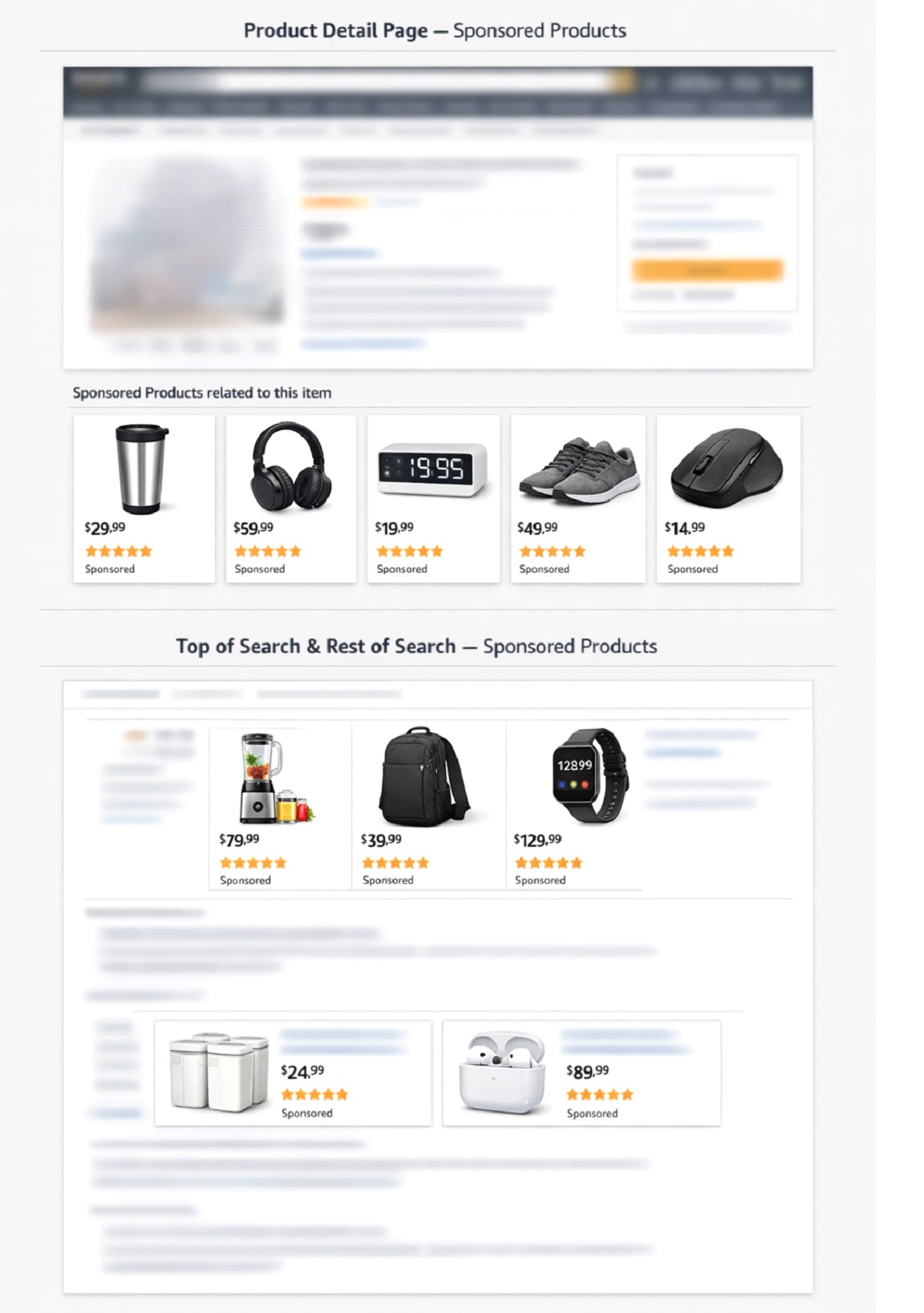
Ads can serve across supported desktop and mobile experiences.
The exact placement is not something a seller buys outright. Ad delivery depends on eligibility, relevance, bids, budget, and auction conditions.
That distinction matters when troubleshooting. Low impressions do not automatically mean the bid is too low. The product, targeting, campaign settings, and offer eligibility may also be limiting delivery.
Who Is Eligible to Use Sponsored Products?
Amazon lists Sponsored Products as available to professional sellers, vendors, authors, and other eligible advertisers.
For seller listings, Amazon Ads requires the product to meet Sponsored Products eligibility requirements and be eligible for the Featured Offer, commonly known as the Buy Box.
Note: Amazon updated its Featured Offer eligibility requirements in July 2026. For more details, see our article on the Amazon Featured Offer eligibility update.
Amazon also states that a Sponsored Products ad receives no impressions when the advertised SKU does not hold the Featured Offer, even when the campaign appears to be active.
Before optimizing bids, check the retail basics:
- Is the product in stock?
- Is the price competitive?
- Is the detail page ready to convert?
- Is the advertised offer eligible to serve?
- Is the campaign actually delivering impressions?
A campaign cannot bid its way out of every retail problem.
How Do Amazon Sponsored Products Work?
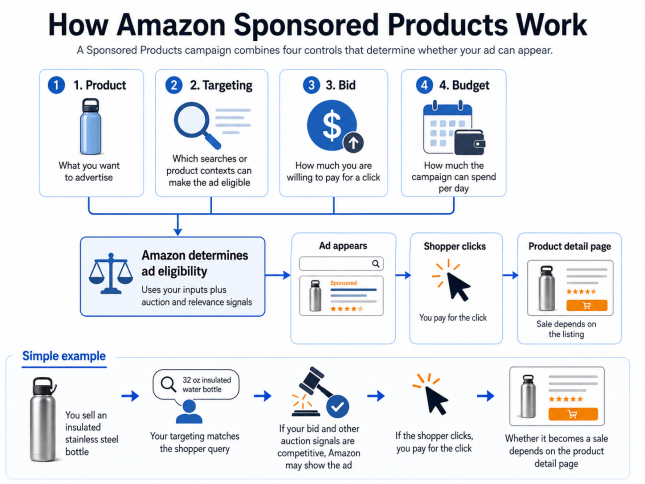
A Sponsored Products campaign combines four controls:
- Product: What you want to advertise
- Targeting: Which searches or product contexts can make the ad eligible
- Bid: How much you are willing to pay for a click
- Budget: How much the campaign can spend per day
Amazon uses these inputs along with auction and relevance signals to determine whether an ad can appear.
Here is a simple example:
You sell an insulated stainless steel bottle. A shopper searches for “32 oz insulated water bottle.” Your targeting makes the campaign eligible for that query. If the bid and other auction signals are competitive, Amazon may show the ad.
If the shopper clicks, you pay for the click. Whether the click becomes a sale depends largely on what happens next on the product detail page.
Automatic vs. Manual Targeting
Sponsored Products has two main targeting methods: automatic and manual.
Automatic Targeting Discovers Opportunities
With automatic targeting, Amazon matches ads with relevant shopper queries and products based on the advertised product and shopping signals.
Amazon provides four automatic targeting groups:
- Close match
- Loose match
- Substitutes
- Complements
This makes automatic targeting useful for discovery. It can surface search terms and product contexts that you may not have chosen yourself.
Manual Targeting Gives You More Control
With manual targeting, you choose the targets.
Manual campaigns can use:
- Keyword targeting
- Product or ASIN targeting
- Category targeting
You can also manage bids at a more specific target level.
The practical difference is not that one method is “good” and the other is “bad.” They solve different jobs.
Use automatic targeting to discover. Use manual targeting when you want more deliberate control over known keywords, ASINs, or categories.
For a deeper decision framework, see our Amazon Automatic vs. Manual Campaigns guide.
Keyword vs. Product Targeting
Manual Sponsored Products campaigns can target shoppers in two different ways.
Keyword Targeting Follows Search Intent
Keyword targeting connects your ad with shopper search terms.
Amazon supports broad, phrase, and exact match. Match type controls how closely the shopper’s search needs to relate to your keyword.
A keyword campaign works well when you know how shoppers describe the problem or product they want.
Product Targeting Follows Product Context
Product targeting lets you target specific ASINs or categories.
This is useful when you want to appear around:
- Similar products
- Competing products
- Complementary products
- Selected product categories
For a deeper explanation of keywords, ASINs, categories, and match types, see our Amazon PPC Targeting: Keyword vs. Product Targeting guide.
How Much Do Amazon Sponsored Products Cost?
Your total Sponsored Products ad spend depends on two things:
Ad Spend = Cost per Click (CPC) × Number of Clicks
For example, if your average CPC is $1.00 and your ads receive 100 clicks, your total ad spend would be about $100.
There is no single standard CPC for Amazon Sponsored Products. The amount you pay per click can vary based on factors such as:Product category
- Keyword or product-target competition
- Bid level
- Placement
- Seasonality
- Marketplace
- Auction conditions
Your bid and CPC are also not the same thing.
Bid is the maximum amount you are willing to bid for a click.
CPC is the actual amount you pay when a shopper clicks your ad.
Because CPC varies, there is also no single “right” Sponsored Products budget for every seller.
A more useful question is:
“What CPC can this product afford while still meeting its ACoS or profit goal?”
A simple planning model is:
Break-even CPC ≈ Conversion Rate × Profit Available Before Ad Spend
For example, if a product can support $10 in profit before advertising and converts 10% of ad clicks, a rough break-even CPC would be $1.00.
This is an illustrative planning model, not an Amazon formula. Actual performance can vary.
For a deeper explanation of CPC, bids, bidding strategies, placements, and daily budgets, see our Amazon PPC Bidding guide.
How to Launch a Sponsored Products Campaign
Amazon’s setup flow is straightforward, but each step affects the quality of the data you collect later.
1. Choose Products That Are Ready for Paid Traffic
Start with products that are:
- In stock
- Competitively priced
- Supported by a strong detail page
- Eligible to serve Sponsored Products ads
If a listing has weak conversion, adding more clicks can increase spend faster than sales.
2. Set a Campaign Goal
Decide what the campaign is supposed to accomplish.
Common goals include:
- Launch a new product
- Increase sales for an established ASIN
- Discover new search terms
- Reach shoppers browsing competing or related products
- Grow volume within an ACoS goal
The goal gives context to every later optimization decision.
3. Choose Automatic or Manual Targeting
Use automatic targeting when discovery is the priority.
Use manual targeting when you already know which keywords or products you want to control directly.
Many accounts benefit from using both, but keep the purpose of each campaign clear.
4. Set Bids
A bid influences how competitively a target can enter the auction.
Do not assume that raising the bid is always the correct response to low traffic. Check relevance and product readiness first.
5. Set the Daily Budget
The budget controls campaign spending capacity. It is different from the bid.
Bid = How much you are willing to pay for a click
Budget = How much the campaign can spend
A campaign can have sensible bids but still stop serving if its budget is exhausted. It can also have a large budget and still generate little traffic if the targeting or bids are not competitive.
6. Launch and Collect Enough Data to Learn
Avoid overreacting to the first few clicks.
The early job is to collect enough data to answer:
- Which queries are generating traffic?
- Which targets generate sales?
- Which targets spend without converting?
- Is the campaign limited by bids, budget, or conversion?
- Is performance aligned with the campaign’s ACoS goal?
Amazon Sponsored Products Management Starts After Launch
Campaign setup is only the beginning.
Sponsored Products management is the ongoing process of deciding where to increase control, where to reduce waste, and where to give the campaign more room to grow.
A practical weekly workflow looks like this:
1. Check Product and Delivery Health First
Before changing advertising settings, make sure the product is still:
- In stock
- Competitively priced
- Eligible to serve ads
- Supported by a healthy detail page
A retail problem can look like a PPC problem in the campaign report.
2. Review Search Terms, Not Just Keywords
A keyword is a target you choose.
A search term is what the shopper actually typed.
Search terms show how Amazon is translating your targeting into real traffic.
Look for:
- Search terms that convert repeatedly
- Queries that spend without producing sales
- New long-tail terms worth testing
- Irrelevant traffic that should be excluded
For a deeper workflow, see our Amazon Search Term Report guide.
3. Move Proven Targets Into More Controlled Structures
Automatic or broader campaigns can help discover demand.
When a search term or product target proves useful, moving it into a manual structure can give you clearer control over bid and match type.
This is often called harvesting.
4. Add Negative Targets Where the Evidence Supports It
Negative targeting can stop ads from matching unwanted keywords, products, or brands.
Do not negate too quickly. A target with one click and no order is not automatically a bad target.
Use enough data to distinguish random variation from a persistent performance problem.
For a deeper explanation, see our Amazon Negative Keywords guide.
5. Adjust Bids Around the Campaign Goal
A target that converts efficiently may have room for a higher bid.
A target that consumes spend without supporting the ACoS goal may need a lower bid.
The decision should be based on performance and product economics, not on a universal bid rule.
6. Watch Budget Pacing
A budget that runs out early can limit traffic later in the day.
Before increasing budget, check whether the campaign is spending efficiently.
More budget scales both good and bad traffic.
7. Measure ACoS in Context
ACoS shows ad spend divided by attributed ad sales.
It is useful, but it is not the whole business.
A launch campaign may accept a higher ACoS to collect demand and sales history. A mature, margin-sensitive product may need stricter efficiency.
The target should come from the role of the campaign and the economics of the product.
For more detail, see our Amazon ACoS guide.
A Simple Sponsored Products Optimization Framework
When performance changes, diagnose the problem before touching every setting.
| What You See | Check First | Possible Next Action |
|---|---|---|
| Very low impressions | Eligibility, targeting relevance, bids | Fix eligibility/relevance, then evaluate bid |
| Clicks but no sales | Search-term relevance and listing conversion | Refine targets, negatives, listing, or offer |
| Good sales but high ACoS | CPC, bids, conversion, target quality | Lower inefficient bids or remove poor traffic |
| Campaign runs out of budget | Search-term quality and ACoS | Cut waste before increasing budget |
| Automatic campaign finds winners | Search term / ASIN performance | Move proven targets into manual campaigns |
| Manual campaign stops growing | Search coverage and bids | Expand targets or test controlled bid increases |
This keeps optimization tied to cause and effect.
It also prevents a common mistake: using the bid as the answer to every problem.
For a complete workflow, see our Amazon PPC Optimization guide.
When Does Sponsored Products Automation Make Sense?
Manual campaign management becomes heavier as the account grows.
One product may only have a few targets. A larger catalog can create hundreds or thousands of keyword, ASIN, bid, and negative-target decisions.
Automation is most useful when the decision logic is repetitive and the goal is already clear.
Examples include:
- Adjusting bids toward an ACoS goal
- Reviewing performance across many targets
- Moving proven search terms into more controlled targeting
- Adding negative keyword or product targets based on performance
- Repeating these decisions across many ad groups
BQool Advertising is designed around these workflows.
AI-Bidding can automate bid adjustments toward an ACoS goal. BQool’s AI-Bidding also considers performance patterns by day of week and time of day when adjusting bids.
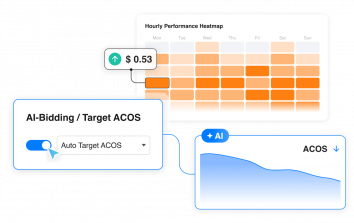
AI-Harvesting can help identify and add useful keyword or product targets while also adding negative keyword or product targets based on performance.
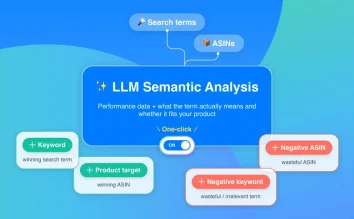
Automation should not be treated as permission to ignore the account. Sellers still need to set business goals, maintain healthy listings and inventory, and review whether the campaign strategy makes sense.
Common Sponsored Products Mistakes
Treating Bids as the Only Optimization Lever
A higher bid can increase auction competitiveness.
It cannot fix irrelevant targeting or a weak detail page.
Mixing Discovery and Control Without a Plan
Automatic and broad targeting are useful for discovery.
Proven terms often deserve a clearer manual structure.
Negating Search Terms Too Early
Removing traffic after too little data can cut off terms that simply have not had enough opportunity to convert.
Increasing Budget Before Removing Waste
If a campaign is already inefficient, a larger budget can amplify the inefficiency.
Optimizing for ACoS Without Considering Margin
The same ACoS can be profitable for one product and unprofitable for another.
Letting Campaign Structure Become Too Fragmented
More campaigns do not automatically create more control.
Structure should make decisions easier, not create extra maintenance with no clear purpose.
Key Takeaway
Amazon Sponsored Products are easy to launch because the format is simple: choose a product, choose targeting, set bids and budget, and send shoppers directly to the product detail page.
The real work begins after launch.
Good Sponsored Products management connects search-term relevance, targeting, bids, budget, conversion, and ACoS.
Start broad enough to learn, move proven opportunities into more controlled structures, cut genuinely inefficient traffic, and automate repetitive decisions when the account becomes too large to manage consistently by hand.
Explore Other Types of Amazon Sponsored Ads
Sponsored Products are only one part of Amazon’s advertising ecosystem.
Amazon also offers Sponsored Brands and Sponsored Display, and each ad type supports a different goal—from driving sales for individual products to building brand awareness and reaching shoppers across more stages of the buying journey.
If you’re not sure how they differ or which format fits your campaign goals, read our guide to the different types of Amazon Ads for a side-by-side look at Sponsored Products, Sponsored Brands, and Sponsored Display.
Frequently Asked Questions
What Are Sponsored Products on Amazon?
Sponsored Products are cost-per-click ads for individual Amazon product listings. They can appear in shopping results and on product detail pages.
How Do Amazon Sponsored Product Ads Work?
You select products, targeting, bids, and a daily budget. Amazon determines when the ad is eligible to enter an auction. You pay when a shopper clicks the ad.
How Much Do Amazon Sponsored Products Cost?
There is no single standard CPC. Sponsored Products use cost-per-click pricing, and actual CPC varies by auction competition, targeting, bids, placement, category, and marketplace.
What Is the Difference Between Automatic and Manual Sponsored Products Campaigns?
Automatic targeting lets Amazon match the ad with relevant searches and products. Manual targeting lets the advertiser choose specific keywords, ASINs, or categories.
How Should I Manage Sponsored Products After Launch?
Review search terms, target performance, bids, negative targets, budget pacing, conversion, and ACoS.
Make changes based on patterns rather than isolated clicks.
Can Amazon Sponsored Products Management Be Automated?
Parts of the workflow can be automated with PPC software like BQool Advertising, including bid optimization and search-term harvesting.
Sellers should still define campaign goals and monitor product, inventory, and profitability.
The post Amazon Sponsored Products: How They Work and How to Manage Them appeared first on BQool Blog.
Amazon PPC Optimization: How to Improve Campaign Performance
Launching an Amazon PPC campaign is only the beginning.
Once the campaign starts collecting data, optimization is about answering three questions:
- What is working?
- What is limiting performance?
- What should you change next?
The third question depends on the first two.
If impressions are low, raising the budget may not help. If shoppers click but do not buy, changing bids may not solve the real problem. And if a campaign already spends inefficiently, giving it more budget can simply create more inefficient spend.
Good Amazon PPC optimization starts with diagnosis before action.
Overview
- Amazon PPC Optimization in 30 Seconds
- What Is Amazon PPC Optimization?
- Start With Your Campaign Goal
- Find Where Performance Is Breaking Down
- Step 1: Check Product and Ad Delivery First
- Step 2: Improve the Quality of Your Traffic
- Step 3: Adjust Bids Based on Performance
- Step 4: Review Budget After Traffic Quality
- Step 5: Check Conversion When Clicks Do Not Become Sales
- Step 6: Measure ACoS in Context
- What About Placement and Dayparting?
- When Does Amazon PPC Automation Make Sense?
- Common Amazon PPC Optimization Mistakes
- Key Takeaway
- Frequently Asked Questions
Amazon PPC Optimization in 30 Seconds
| What You See | Check First | Possible Next Step |
|---|---|---|
| Very low impressions | Eligibility, targeting, bids | Fix delivery or relevance, then evaluate bids |
| Impressions but few clicks | Target relevance, product offer | Improve traffic relevance or product appeal |
| Clicks but few sales | Search terms, targeting, product detail page | Refine traffic or improve conversion |
| Sales but high ACoS | CPC, conversion, target performance | Reduce inefficient spend |
| Campaign runs out of budget | Traffic quality and ACoS | Remove waste before adding budget |
| Campaign performs well but has low volume | Coverage, bids, budget | Look for controlled ways to scale |
The goal is not to change everything at once.
Find the constraint, make the change that addresses it, then measure again.
What Is Amazon PPC Optimization?
Amazon PPC optimization is the ongoing process of improving how efficiently a campaign reaches its goal.
That can involve:
- Improving targeting
- Reviewing search terms
- Adjusting bids
- Removing inefficient traffic
- Managing budget
- Improving conversion
- Expanding campaigns that already perform well
Optimization does not always mean lowering ACoS.
A new product campaign may accept higher advertising costs while it builds visibility and collects data. A mature product with tight margins may need a much stricter efficiency target.
The right optimization decision depends on what the campaign is supposed to achieve.
Start With Your Campaign Goal
Before changing bids, targets, or budgets, define what good performance means for the campaign.
For example, a campaign may be designed to:
- Launch a new product
- Discover new search terms
- Generate profitable sales
- Increase sales volume
- Reach shoppers around competing products
- Grow within a target ACoS
The same performance data can lead to different decisions depending on that goal.
A higher ACoS may be acceptable during product discovery but unsustainable for a campaign focused on profit.
Without a goal, optimization can become a series of disconnected changes.
Find Where Performance Is Breaking Down
A simple way to diagnose Amazon PPC is to follow the path from visibility to sale:
Impressions → Clicks → Product Detail Page → Orders → Advertising Efficiency
Each stage answers a different question.
| Stage | Question |
|---|---|
| Impressions | Is the ad getting enough opportunities to appear? |
| Clicks | Are relevant shoppers interested enough to visit the listing? |
| Conversion | Are those shoppers buying after they click? |
| Cost | How much are you paying for that traffic? |
| ACoS / ROAS | Is the result aligned with the campaign goal? |
Do not jump to the last metric before understanding what happened earlier in the path.
A high ACoS, for example, is an outcome. The underlying cause may be expensive clicks, weak conversion, poor targeting, or a combination of them.
Step 1: Check Product and Ad Delivery First
Before changing advertising settings, make sure the advertised product can compete effectively.
Check basic issues such as:
- Product availability
- Sponsored Products eligibility
- Featured Offer eligibility
- Price and offer competitiveness
- Product detail page quality
A retail problem can look like an advertising problem.
For example, if a product receives clicks but suddenly stops converting after its price increases, lowering the bid may reduce spend—but it does not fix the reason shoppers stopped buying.
Start by confirming that the campaign and the product are healthy enough to optimize.
Step 2: Improve the Quality of Your Traffic
Once delivery looks healthy, check whether the campaign is attracting the right shoppers.
Amazon’s Search Term Report shows the search terms that generated at least one ad click and can help identify both high-performing searches and traffic that does not support your goals.
Look for patterns such as:
- Search terms generating consistent sales
- Relevant terms worth managing more directly
- Queries consuming spend without enough return
- Irrelevant traffic
- Product targets that consistently perform well or poorly
The action depends on what the data shows.
A strong search term may be worth adding as a more controlled target. Poor or irrelevant traffic may call for negative targeting.
You do not need to make those decisions from one click or one order. Look for enough evidence to identify a meaningful pattern.
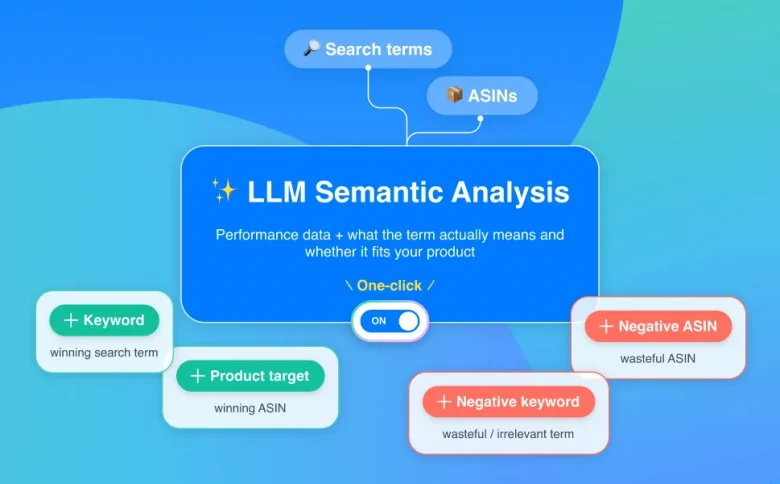
As campaigns grow, reviewing and moving search terms or product targets manually can become repetitive. BQool’s AI-Harvesting can automate this workflow by identifying useful keyword and product opportunities while also adding negative targets based on performance.
Step 3: Adjust Bids Based on Performance
After confirming that the traffic itself makes sense, look at what you are paying for it.
Your bid affects how competitively a target can compete in the auction. But before raising or lowering it, first ask what is actually going wrong.
- Is the target getting traffic but not sales?
The problem may be relevance or conversion, not the bid. - Is the target generating sales but spending too much to get them?
The bid may be too aggressive for your ACoS goal. - Is the target converting efficiently but getting very little traffic?
A higher bid may give it more opportunities to compete. - Is the target barely getting impressions or clicks?
Check relevance and eligibility before assuming the bid is too low.
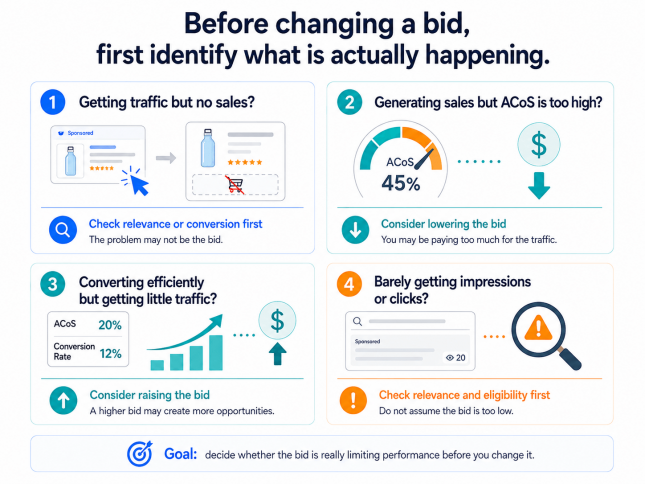
A lower bid can reduce how aggressively you compete, but it cannot fix poor targeting or weak conversion. Likewise, a higher bid may create more opportunities, but it cannot make an irrelevant target relevant.
The goal is to identify whether the bid is actually limiting performance before changing it.
If bid is the right lever, the next question is how much you can afford to bid and how large the adjustment should be. See our Amazon Bidding Strategy guide for starting bids, bid adjustments, bidding strategies, and placement bidding.
Step 4: Review Budget After Traffic Quality
A campaign running out of budget is not automatically a signal to increase it.
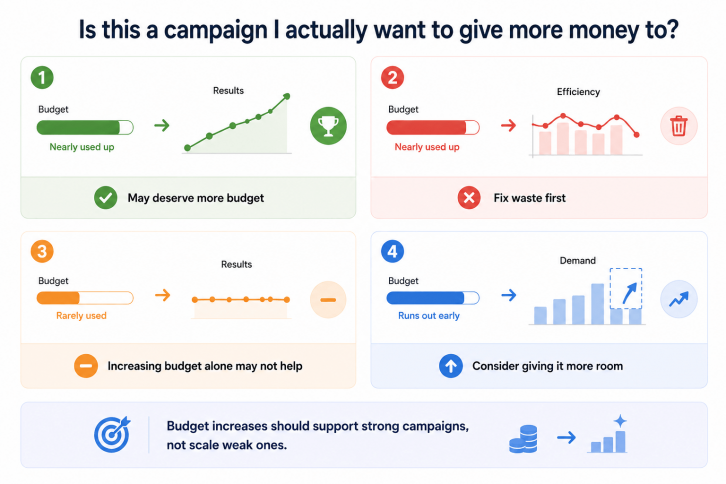
First ask:
Is this a campaign I actually want to give more money to?
Then look at what is happening:
- Is the campaign running out of budget while meeting your performance goal?
It may have room for more budget. - Is it running out of budget but spending inefficiently?
Fix the wasted spend before giving it more money. - Does the campaign rarely use its full budget?
Increasing the budget alone is unlikely to create more traffic. - Is a strong campaign losing opportunities because its budget runs out early?
Increasing its budget may help it capture more of the available demand.
Budget controls spending capacity, not efficiency. Giving an inefficient campaign more budget can simply scale the problem.
The goal is to determine whether budget is actually limiting a campaign that deserves more room to grow.
If budget is the right lever, the next question is how much the campaign needs and how much additional spend you can support. See our How Much Should I Spend on Amazon Ads? guide for daily budget planning, budget adjustments, and scaling decisions.
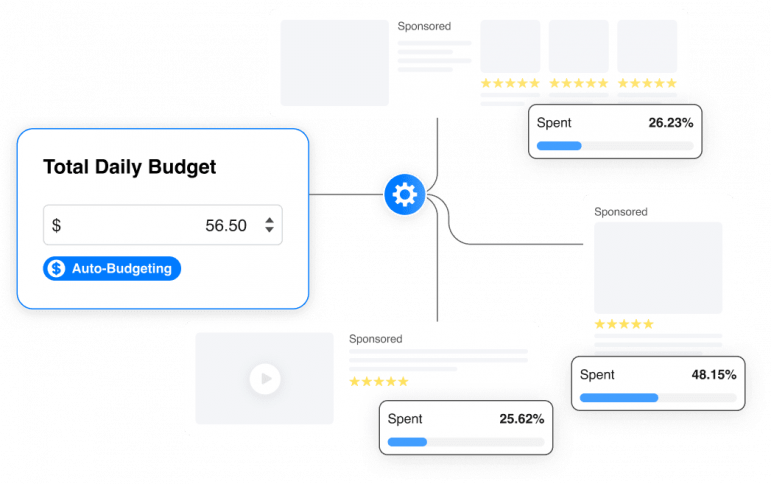
For sellers managing multiple campaigns, budget allocation can also become a recurring optimization task. BQool’s Auto Budgeting can automatically shift budget toward stronger-performing campaigns, helping keep productive campaigns active without requiring constant manual budget monitoring.
Step 5: Check Conversion When Clicks Do Not Become Sales
If a campaign generates relevant clicks but few orders, the problem may no longer be primarily about getting traffic.
The shopper has already reached the product detail page.
Now ask whether the offer gives them enough reason to buy.
Check factors such as:
- Price
- Images
- Reviews and ratings
- Product title and key information
- Offer competitiveness
- Inventory
- Product-market fit
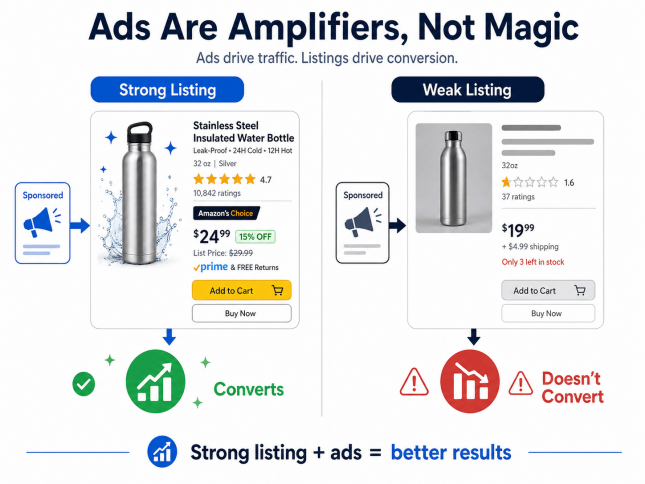
This is why PPC optimization does not stop inside the advertising console.
A campaign can deliver relevant shoppers efficiently and still perform poorly if the listing does not convert them.
Changing bids can control how much you pay for those clicks. It cannot make the product detail page convert.
If you need help diagnosing both advertising and conversion problems, BQool’s Amazon Ads Management Service combines campaign optimization with hands-on guidance from an experienced PPC team, including recommendations for improving product listings.
See how BQool combined PPC management and listing recommendations in this Amazon Ads customer success story.
Step 6: Measure ACoS in Context
After making changes, evaluate whether performance is moving toward the campaign goal.
ACoS is one of the most common Amazon PPC metrics:
ACoS = Ad Spend ÷ Ad Sales × 100
But a lower ACoS is not automatically better in every situation.
For example:
- Lowering bids may improve ACoS but reduce sales volume.
- Expanding targeting may temporarily increase ACoS while uncovering new demand.
- A profitable high-margin product may tolerate a different ACoS than a low-margin product.
The important question is:
Is the campaign producing an acceptable result for this product and this goal?
For break-even ACoS, benchmarks, and profitability context, see our Amazon ACoS guide.
What About Placement and Dayparting?
Targeting, bids, and budget are not the only dimensions that can affect PPC performance.
Placement
Sponsored Products performance can differ depending on where ads appear, such as Top of Search, Rest of Search, or Product Pages.
Amazon provides placement reporting so advertisers can compare performance across placements and evaluate whether placement-level bid adjustments make sense.
Placement optimization deserves its own analysis because the question is not simply:
Which placement gets more sales?
It is:
Which placement produces results that justify what I am paying for it?
Dayparting
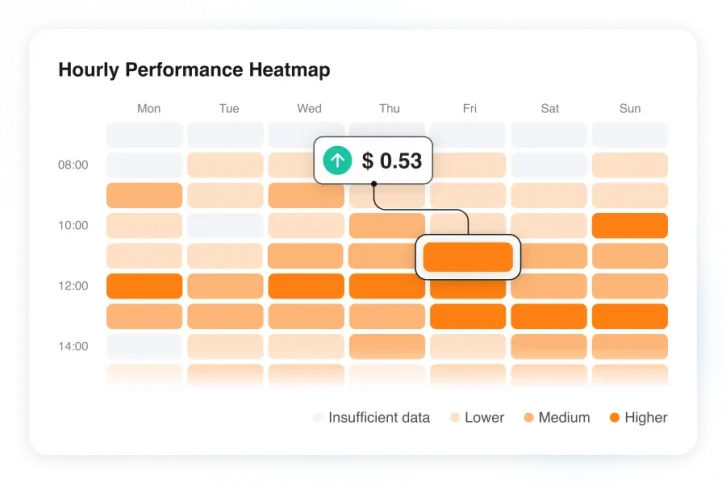
Performance may also change by day of week or time of day.
Dayparting adjusts how aggressively you bid based on when your ads tend to perform better or worse.
In practice, manual dayparting can be difficult for beginners. You need enough performance data to compare different days and times, identify meaningful patterns, decide which periods deserve higher or lower bids, and continue updating those decisions as performance changes.
BQool’s AI-Bidding automates this process. It analyzes historical advertising performance by day of week and time of day, then adjusts bidding based on those patterns.
Higher-performing periods can receive more aggressive bids, while lower-performing periods can be bid more conservatively, without requiring you to build hourly schedules or manage separate dayparting rules manually.
When Does Amazon PPC Automation Make Sense?
Manual optimization becomes harder as the number of campaigns, keywords, ASINs, and decisions grows.
Automation becomes most useful when:
- The campaign goal is already clear
- The decision logic is repeatable
- Enough performance data exists
- Manual review is becoming difficult to perform consistently
Common repetitive workflows include:
- Adjusting bids toward an ACoS goal
- Reviewing large numbers of targets
- Identifying useful search terms or ASINs
- Adding negative keyword or product targets
- Reallocating budget across campaigns based on performance
- Applying decisions across many campaigns
BQool Advertising automates several parts of this workflow:
- AI-Bidding adjusts bids based on performance and your ACoS goal.
- AI-Harvesting identifies useful keyword and product opportunities while adding negative targets.
- Auto Budgeting helps allocate budget toward stronger-performing campaigns.
Automation does not replace campaign strategy. You still need to decide what good performance means for your products.
It helps execute those decisions more consistently as the amount of manual work grows.
Common Amazon PPC Optimization Mistakes
Changing Too Many Things at Once
If you change targeting, bids, budget, and listing content at the same time, it becomes harder to understand what caused the result.
Make deliberate changes where possible and evaluate what happens next.
Treating Bids as the Answer to Every Problem
Low traffic does not always mean the bid is too low.
High ACoS does not always mean the bid is too high.
Check relevance and conversion before assuming price is the problem.
Increasing Budget Before Removing Waste
More budget gives a campaign more capacity to spend.
It does not make the spend more efficient.
Fix obvious inefficiency before deciding whether the campaign deserves more budget.
Optimizing Only for ACoS
ACoS is useful, but it is not the campaign goal by itself.
A lower ACoS with sharply lower sales is not necessarily an improvement.
Evaluate efficiency together with sales volume, margin, and the role of the campaign.
Making Decisions From Too Little Data
One click, one order, or one bad day can create noise.
Optimization should respond to meaningful patterns rather than isolated results.
Key Takeaway
Amazon PPC optimization is not about finding one setting that makes every campaign perform better.
It is a repeated decision process:
Set the goal → Find the constraint → Make the relevant change → Measure again
Start with product and delivery health. Then evaluate traffic quality, bids, budget, conversion, and efficiency in that order.
As campaigns grow, automation can help repeat those decisions more consistently—but the logic behind the decisions still matters.
Frequently Asked Questions
What Is Amazon PPC Optimization?
Amazon PPC optimization is the ongoing process of improving campaign performance by reviewing targeting, search terms, bids, budget, conversion, and advertising efficiency.
How Do You Optimize an Amazon PPC Campaign?
Start by identifying the campaign goal and locating where performance is breaking down. Then adjust the factor most closely connected to the problem rather than changing every campaign setting at once.
How Often Should You Optimize Amazon PPC?
There is no single review frequency that fits every campaign.
Campaigns with more traffic collect meaningful data faster than low-volume campaigns. Review performance regularly, but base changes on enough data to support the decision rather than a fixed number of days.
How Can I Reduce Amazon PPC ACoS?
High ACoS can come from several causes, including high CPC, poor conversion, or inefficient traffic.
Identify which factor is driving the problem before lowering bids or adding negative targets.
Should I Increase the Budget When an Amazon PPC Campaign Runs Out?
Not automatically.
First check whether the campaign is meeting its performance goal. If it is efficient and budget-limited, more budget may create room to grow. If it is inefficient, remove waste before increasing spend.
What Should I Do if My Amazon Ads Get Clicks but No Sales?
Check whether the traffic is relevant and whether the product detail page is converting shoppers effectively.
Search terms, targeting, price, reviews, images, offer competitiveness, and product-market fit can all affect the path from click to sale.
Can Amazon PPC Optimization Be Automated?
Parts of it can.
Bid adjustments, search-term harvesting, negative targeting, and budget allocation can all be automated when campaigns have enough data and a clear goal.
The post Amazon PPC Optimization: How to Improve Campaign Performance appeared first on BQool Blog.
Amazon Automatic vs Manual Campaigns: What’s the Difference?
When you create an Amazon Sponsored Products campaign, one of the first decisions you make is whether to use automatic or manual targeting.
The difference is simple:
Automatic targeting lets Amazon decide which shopper searches and products may be relevant to your ad. Manual targeting lets you choose the keywords or products you want to target.
Neither option is always better.
Automatic campaigns can help you discover new opportunities with less setup. Manual campaigns give you more control once you know what you want to target.
For many sellers, the better strategy is not choosing one over the other. It is understanding what job each campaign should do.
Overview
- Amazon Automatic vs Manual Campaigns in 30 Seconds
- What Is an Amazon Automatic Campaign?
- How Does Amazon Automatic Targeting Work?
- What Are Automatic Campaigns Good For?
- What Is an Amazon Manual Campaign?
- Automatic vs Manual Campaigns: What Is the Real Difference?
- Should Beginners Start With Automatic or Manual Campaigns?
- How Automatic and Manual Campaigns Can Work Together
- Automatic vs Manual Campaign Example
- Common Automatic vs Manual Campaign Mistakes
- When Does Automation Make This Workflow Easier?
- Automatic or Manual: Which Should You Choose?
- Frequently Asked Questions
Amazon Automatic vs Manual Campaigns in 30 Seconds
| Automatic Campaign | Manual Campaign | |
|---|---|---|
| Who chooses the targets? | Amazon | You |
| Targets | Shopper searches and products Amazon considers relevant | Keywords, products, ASINs, or categories you select |
| Setup | Faster | Requires more input |
| Control | Less direct control | More control over individual targets |
| Best for | Discovery and learning | Controlling proven or planned targets |
| Can you set bids? | Yes, including bids by automatic targeting group | Yes, including bids for individual targets |
| Should you use both? | Often, yes | Often, yes |
Amazon itself recommends using a mix of automatic and manual targeting rather than treating them as mutually exclusive strategies.
What Is an Amazon Automatic Campaign?
In an automatic Sponsored Products campaign, Amazon uses information about your advertised product and shopping activity to match your ad with relevant shopper queries and products.
You do not need to build a keyword list before launching the campaign.
This makes automatic targeting one of the easiest ways for a new advertiser to start collecting data about how shoppers are finding products like yours. Amazon describes automatic targeting as a quick way to get started while gaining insights that can later inform your advertising strategy.
How Does Amazon Automatic Targeting Work?
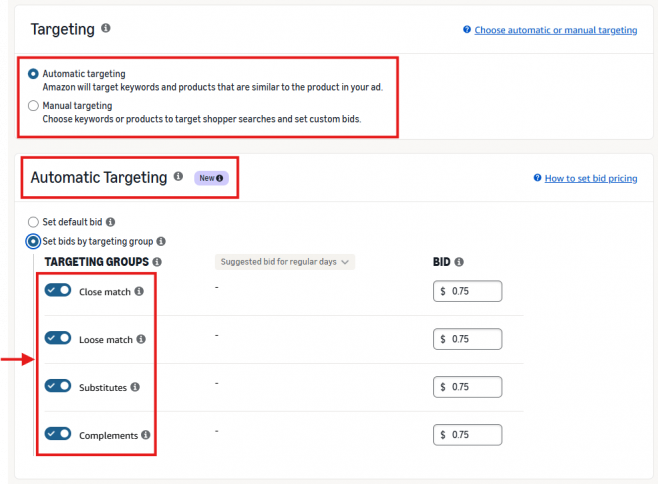
Amazon divides automatic targeting into four groups:
- Close match: Your ad may appear for shopping terms closely related to your product.
- Loose match: Your ad may appear for shopping terms more broadly related to your product.
- Substitutes: Your ad may appear around products that shoppers could consider instead of yours.
- Complements: Your ad may appear around products that complement yours.
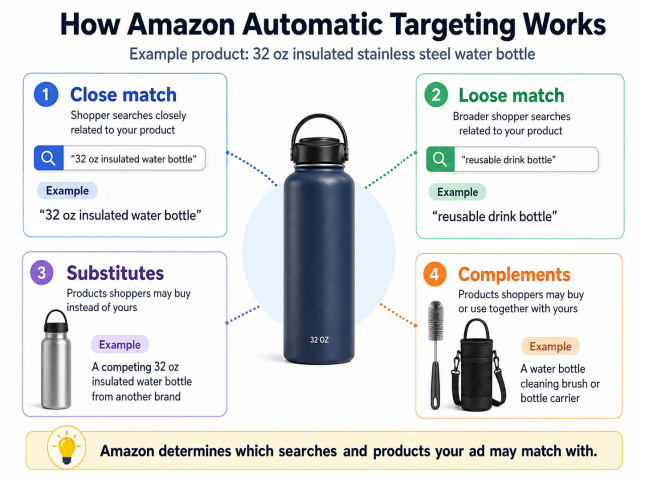
For example, imagine you sell an insulated stainless steel water bottle.
Amazon might connect your automatic campaign with:
- Close match: “32 oz insulated water bottle”
- Loose match: “reusable drink bottle”
- Substitute: A competing 32 oz insulated water bottle from another brand
- Complement: A water bottle cleaning brush or bottle carrier
Amazon determines which searches and products your ad may match with.
What Are Automatic Campaigns Good For?
Automatic campaigns are particularly useful when you want to:
- Launch a campaign quickly
- Discover search terms you did not think of yourself
- Find product or ASIN targeting opportunities
- Learn how Amazon connects your listing with shopper demand
- Gather data before building more controlled manual targeting
The main value of automatic targeting is discovery.
An automatic campaign can show you where demand exists. It does not mean every search term or product Amazon matches with your ad will be profitable.
That is why the work does not stop after launching the campaign.
What Is an Amazon Manual Campaign?
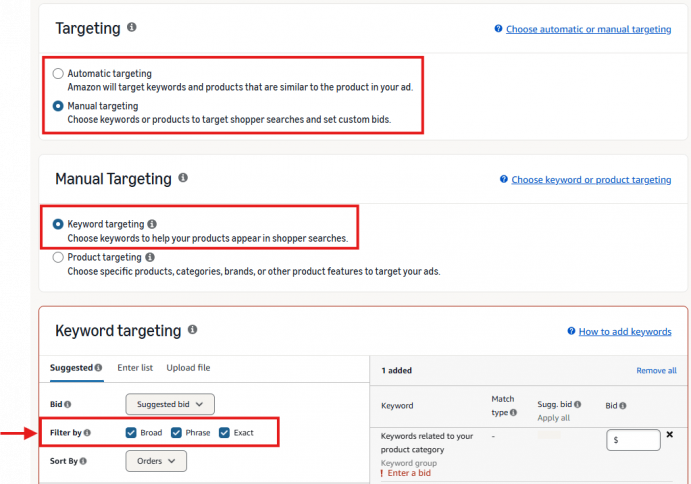
With manual targeting, you decide what you want your Sponsored Products ads to target.
Amazon allows advertisers to manually select keywords or products, giving sellers more control over individual targets and their bids.
Manual targeting generally falls into two categories:
- Keyword targeting
- Product targeting
Keyword Targeting
Keyword targeting lets you select the keywords shoppers may use when searching for products like yours.
For example, if you sell an insulated water bottle, you might target:
- insulated water bottle
- stainless steel water bottle
- 32 oz water bottle
You can then use broad, phrase, or exact match to control how closely shopper searches need to relate to your keyword.
If you are not sure which terms to target, see our guide on how to find keywords for Amazon PPC.
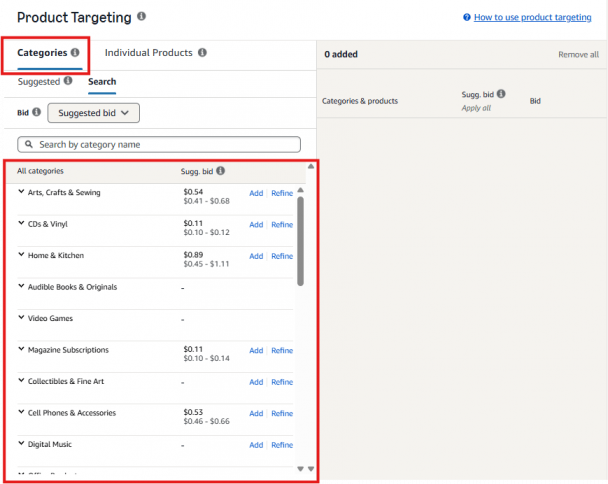
Product Targeting
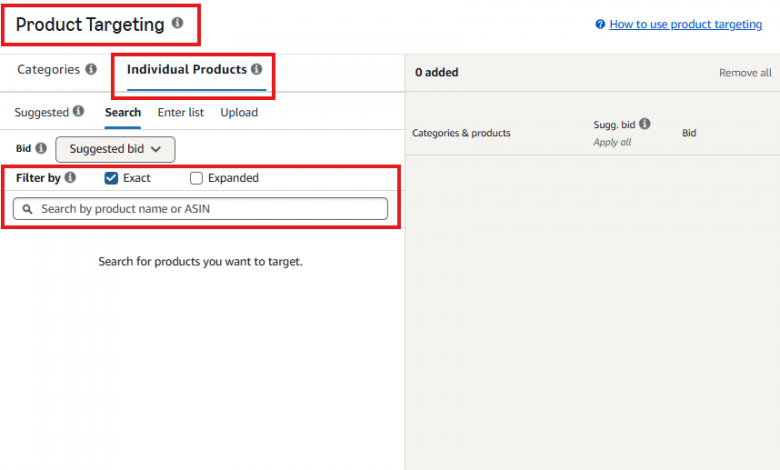
Product targeting lets you target:
- Product categories
- Specific products or ASINs
For example, you might target a competing product that is similar to yours, or a product that shoppers commonly use together with yours.
Instead of asking:
“What words might the shopper search?”
you are asking:
“Which products or categories do I want my product to appear around?”
We will cover keyword targeting, product targeting, ASIN targeting, categories, and match types in more detail in our Amazon PPC Targeting: Keyword vs Product Targeting guide.
Automatic vs Manual Campaigns: What Is the Real Difference?
The biggest difference is who decides what the campaign targets.
With automatic targeting:
Amazon discovers matching opportunities for you.
With manual targeting:
You decide which opportunities you want to pursue.
That difference affects how you use the campaign.
Automatic Gives You More Discovery
You may not know every search term shoppers use for your product.
An automatic campaign can reveal:
- Unexpected long-tail searches
- Different ways shoppers describe your product
- Relevant competing products
- Complementary product opportunities
That makes it useful when your knowledge of the market is incomplete.
Manual Gives You More Control
Once you know which keywords or products matter, manual targeting lets you manage them more deliberately.
For example, you can:
- Select specific keywords
- Choose match types
- Target individual ASINs
- Set different bids for individual targets
- Build campaigns around different goals
Manual does not automatically mean better performance.
It means you have more control over the decisions.
If the targets you choose are poor, manual campaigns can still waste ad spend.
Should Beginners Start With Automatic or Manual Campaigns?
There is no rule that every new seller must start with automatic targeting.
Amazon recommends automatic targeting as an easy way for new advertisers to begin, and its getting-started guidance also suggests using automatic campaigns to discover shopping terms.
But the better choice depends on what you already know.
Start With Automatic Targeting When:
- You are new to Amazon PPC
- You do not have much keyword or product-target data yet
- You want to discover how shoppers find your product
- You want a simpler campaign setup
Start With Manual Targeting When:
- You already know important keywords
- You already know specific ASINs or categories you want to target
- You want tighter control over targeting and bids
- You are building a campaign around a specific strategy
Use Both When:
You want discovery and control at the same time.
This is often the most useful way to think about automatic vs manual campaigns.
Automatic campaigns can continue looking for opportunities, while manual campaigns focus on targets you have deliberately chosen.
How Automatic and Manual Campaigns Can Work Together
Automatic and manual campaigns do not need to compete for the same job.
A simple workflow looks like this:
Automatic campaign → Discover search terms and products → Review performance → Identify useful targets → Add proven targets to manual campaigns
For example:
You advertise an insulated bottle through an automatic campaign.
Amazon matches your ad with the shopper search:
“32 oz stainless steel water bottle with straw”
After enough data, you see that this search term repeatedly generates sales at an acceptable ACoS.
Instead of leaving that opportunity only inside the automatic campaign, you may decide to add it to a manual keyword campaign where you can control the keyword, match type, and bid more directly.
This process is often called keyword harvesting.
The same idea can apply to products or ASINs discovered through automatic targeting.
Use Search Term Data Before Moving Targets
Do not move every search term from an automatic campaign into a manual campaign.
The goal is to identify patterns that support a decision.
Amazon’s search term report shows the actual shopping queries that generated ad traffic and can help identify high-performing terms worth using in manual targeting.
Look for questions such as:
- Is this search term relevant to my product?
- Has it generated enough traffic to evaluate?
- Is it producing orders?
- Is its ACoS aligned with my campaign goal?
- Is it worth controlling separately?
For a step-by-step explanation, see our Amazon Search Term Report guide.
What Happens to Poor Search Terms?
Automatic campaigns can also reveal traffic you do not want.
For example, you may discover:
- Irrelevant shopper queries
- Products that generate clicks but consistently fail to convert
- Search terms that consume too much spend relative to sales
These are potential negative-targeting opportunities.
Negative targeting can prevent ads from appearing for specific keywords, products, or brands that do not support your campaign goals.
But avoid making decisions from too little data.
One click with no sale does not automatically make a search term bad.
Look for persistent patterns before excluding traffic.
For more detail, read our Amazon Negative Keywords guide.
Do You Need to Move a Winning Search Term Out of the Automatic Campaign?
Not necessarily.
“Harvesting” does not always mean you must completely stop the automatic campaign from accessing the same opportunity.
The important question is what role you want each campaign to play.
You may use the manual campaign to gain clearer control over a proven target while keeping automatic targeting active for continued discovery.
If overlapping traffic makes performance harder to interpret or conflicts with your campaign structure, negative targeting can be used more deliberately.
Avoid building complicated campaign structures only because you believe every target must exist in exactly one place.
Campaign structure should make decisions easier, not create extra maintenance.
Automatic vs Manual Campaign Example
Imagine you are launching a new stainless steel water bottle.
Automatic Campaign
You launch an automatic Sponsored Products campaign to learn how Amazon connects your product with shoppers.
Over time, you discover:
- “32 oz insulated water bottle” converts consistently
- “gym water bottle stainless steel” generates promising sales
- A competing bottle ASIN converts well
- “kids plastic water bottle” spends but is not relevant
Manual Campaign
You can then create more controlled targeting around the opportunities:
- Add “32 oz insulated water bottle” as a manual keyword
- Test “gym water bottle stainless steel”
- Target the high-performing competing ASIN
- Consider excluding irrelevant traffic such as “kids plastic water bottle”
The automatic campaign helped answer:
What opportunities exist?
The manual campaign helps answer:
Which opportunities do I want to control more deliberately?
That is the main reason these campaign types work well together.
Common Automatic vs Manual Campaign Mistakes
Assuming Automatic Campaigns Are Only for Beginners
Automatic targeting can continue to be useful even after you build mature manual campaigns.
It can keep discovering new search terms and product opportunities as shopper behavior changes.
Assuming Manual Campaigns Always Perform Better
More control does not guarantee better results.
Performance still depends on:
- Target quality
- Bids
- Product relevance
- Conversion
- Competition
- Campaign goals
A badly chosen manual keyword can waste just as much money as an irrelevant automatic match.
Moving Search Terms Too Quickly
A search term with a sale is not automatically a proven winner.
Look at enough performance data to determine whether the result is repeatable and aligned with your campaign goal.
Negating Too Quickly
Moving a target to manual does not automatically mean you must immediately negate it from automatic targeting.
Use negatives when they solve a clear problem.
Running Automatic Campaigns Without Reviewing Them
Automatic does not mean “set it and forget it.”
The value of discovery disappears if you never review what the campaign is finding.
Search terms, product targets, bids, negatives, and campaign performance still need attention.
When Does Automation Make This Workflow Easier?
The automatic-to-manual workflow is manageable when you have a small number of campaigns.
It becomes harder when you have to repeatedly:
- Review search terms
- Identify converting keywords or ASINs
- Move useful targets
- Add negative targets
- Adjust bids
- Repeat the same decisions across many campaigns
This is where PPC automation can reduce manual work.
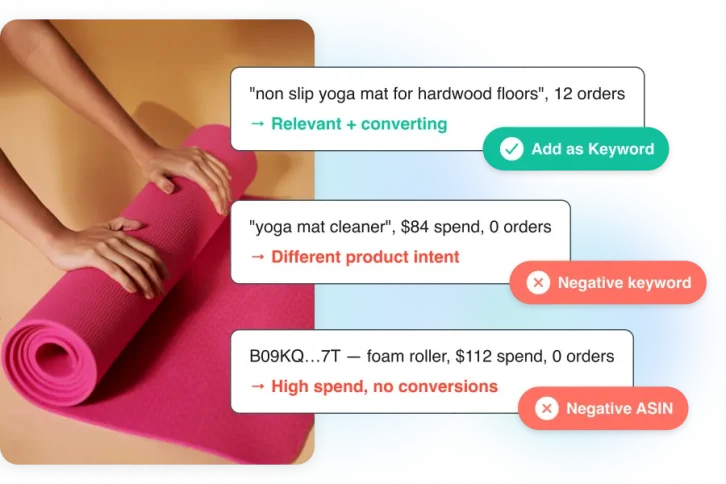
BQool’s AI-Harvesting is designed to help identify useful keyword and product targets while also adding negative keyword or product targets based on performance.
Automation does not replace campaign strategy. You still need to decide what performance goal matters and whether the overall campaign structure makes sense.
Automatic or Manual: Which Should You Choose?
If you only remember one thing, remember this:
Automatic targeting is useful for discovery. Manual targeting is useful for control.
You do not need to choose one forever.
Use automatic campaigns when you want Amazon to help uncover relevant shopper searches and products.
Use manual campaigns when you know which keywords, ASINs, or categories you want to manage more deliberately.
And when both jobs matter, use the two campaign types together—with a clear purpose for each.
Frequently Asked Questions
What Is the Difference Between Automatic and Manual Amazon PPC Campaigns?
Automatic campaigns let Amazon match your Sponsored Products ads with relevant shopper searches and products. Manual campaigns let you choose specific keywords, products, ASINs, or categories to target.
Are Automatic or Manual Amazon Campaigns Better for Beginners?
Automatic targeting is often easier for beginners because it requires less initial targeting research and can help discover opportunities. However, sellers who already know their important keywords or product targets can also start with manual campaigns.
Can You Run Automatic and Manual Amazon Campaigns at the Same Time?
Yes. Automatic campaigns can support discovery while manual campaigns give you more control over selected keywords or product targets. Amazon also recommends incorporating both automatic and manual targeting into your advertising strategy.
When Should You Move a Search Term From Automatic to Manual?
Consider moving a search term when you have enough data to show that it is relevant, performs consistently, and deserves more direct control over its keyword, match type, or bid.
Should You Negate a Keyword After Moving It to a Manual Campaign?
Not automatically. Negative targeting should solve a specific traffic or campaign-structure problem. Avoid negating a term simply because it also exists in a manual campaign.
Can Automatic Campaigns Target Products?
Yes. Amazon automatic targeting can match Sponsored Products ads with shopper searches as well as relevant product detail pages through its close match, loose match, substitutes, and complements targeting groups.
The post Amazon Automatic vs Manual Campaigns: What’s the Difference? appeared first on BQool Blog.
Amazon PPC Targeting: Keyword vs Product Targeting
When you create a manual Sponsored Products campaign, you choose one of two targeting methods:
- Keyword targeting: You select keywords.
- Product targeting: You select specific products or product categories.
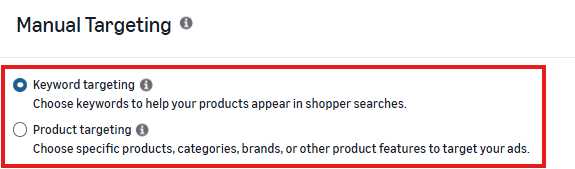
Both methods help Amazon determine when your ad may be eligible to appear, but they give you different ways to control that targeting.
So which one should you use?
That depends on whether you want to manage advertising opportunities through keywords or through products and categories.
Overview
- Amazon PPC Targeting in 30 Seconds
- How Targeting and Ad Placement Work Together
- What Is Amazon Keyword Targeting?
- How Do Amazon Keyword Match Types Work?
- What Is Amazon Product Targeting?
- What Is ASIN Targeting?
- What Is Category Targeting?
- ASIN Targeting vs Category Targeting
- What Is Expanded Product Targeting?
- When Should You Use Keyword Targeting?
- When Should You Use Product Targeting?
- Can You Use Keyword and Product Targeting Together?
- How Do You Find Products to Target?
- What Is Negative Targeting?
- How Search Terms Help Improve Keyword and Product Targeting
- When Does Targeting Automation Make Sense?
- Common Amazon PPC Targeting Mistakes
- Which Targeting Method Should You Choose?
- Frequently Asked Questions
Amazon PPC Targeting in 30 Seconds
| Keyword Targeting | Product Targeting | |
|---|---|---|
| What do you target? | Keywords | Products or categories |
| Main controls | Keywords + match types | ASINs + categories |
| Example target | “32 oz insulated water bottle” | A competing bottle ASIN |
| Possible placements | Shopping results + product pages | Shopping results + product pages |
| Useful when | You know which keywords matter | You know which products or categories matter |
Amazon’s Sponsored Products targeting guidance explains that manual campaigns can use either keyword targeting or product targeting.
How Targeting and Ad Placement Work Together
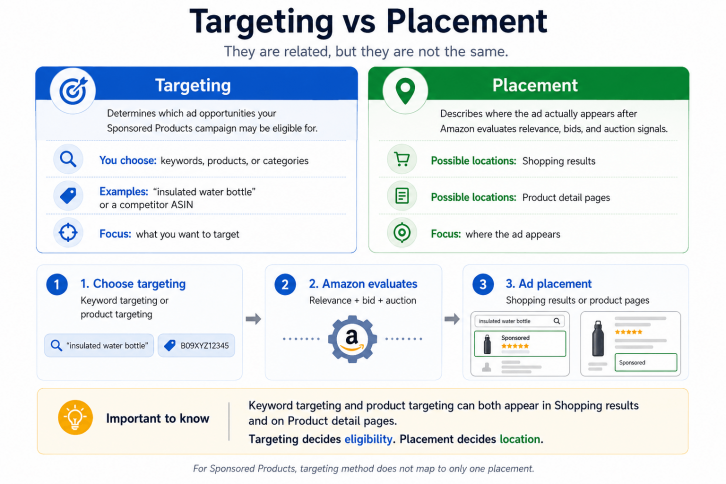
Targeting and placement are related, but they are not the same thing.
Targeting determines which advertising opportunities your ad may be eligible for. Placement describes where the ad actually appears.
For Sponsored Products, both keyword-targeted and product-targeted ads can appear in shopping results and on product detail pages.
This means:
- Keyword targeting does not mean your ads only appear in search results.
- Product targeting does not mean your ads only appear on product detail pages.
The main difference is how you define the target.
With keyword targeting, you choose keywords.
With product targeting, you choose products or categories.
Where the ad ultimately appears also depends on factors such as relevance, bids, auction conditions, and available Sponsored Products placements.
What Is Amazon Keyword Targeting?
Keyword targeting lets you select words or phrases that Amazon can use to match your Sponsored Products ads with relevant shopping activity.
For example, if you sell a 32 oz insulated stainless steel water bottle, you might target:
- insulated water bottle
- stainless steel water bottle
- 32 oz water bottle
- water bottle with straw
Keywords vs Search Terms
A keyword and a search term are not the same thing.
Keyword: What you choose to target.
Search term: What the shopper actually types.
For example:
Keyword: insulated water bottle
Search term: 32 oz insulated water bottle for gym
Your match type helps determine how closely shopper searches need to relate to the keyword you selected.
For more detail on the traffic your ads actually receive, see our Amazon Search Term Report guide.
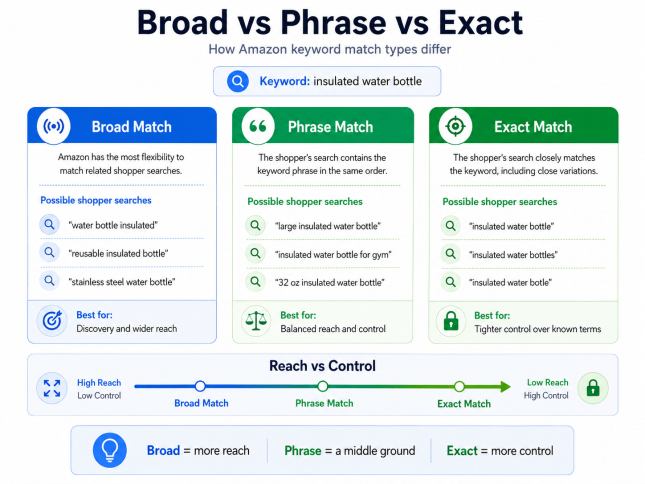
How Do Amazon Keyword Match Types Work?
Sponsored Products supports three keyword match types:
- Broad
- Phrase
- Exact
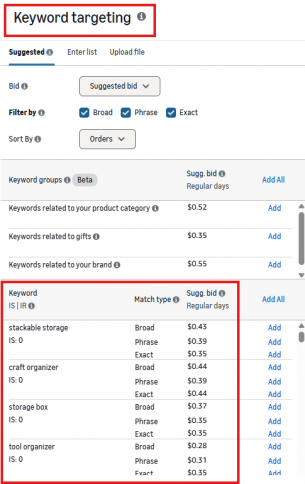
Each match type offers a different balance between reach and control, which affects how broadly Amazon can match your keyword with shopper searches.
| Match Type | Reach | Control | Useful For |
|---|---|---|---|
| Broad | Higher | Lower | Discovery and wider keyword coverage |
| Phrase | Medium | Medium | More focused reach |
| Exact | Lower | Higher | More controlled targeting of known terms |
Broad Match
Broad match gives Amazon the most flexibility to connect your keyword with related shopper searches.
Keyword: insulated water bottle
Possible shopper searches:
- water bottle insulated
- reusable insulated bottle
- stainless steel water bottle
Broad match can help you discover relevant searches beyond the exact keyword you entered. Because the matching is broader, reviewing your search terms is especially important.
Phrase Match
Phrase match requires the shopper’s search to contain your keyword phrase in the same order, while allowing additional words around it.
Keyword: insulated water bottle
Possible shopper searches:
- large insulated water bottle
- insulated water bottle for gym
- 32 oz insulated water bottle
Phrase match gives you more control than broad match while still allowing shoppers to add words before or after your keyword phrase.
Exact Match
Exact match is the most restrictive of the three match types. The shopper’s search needs to closely match your keyword, including supported close variations.
Keyword: insulated water bottle
Possible shopper searches:
- insulated water bottle
- insulated water bottles
- insulated water botle
Exact match gives you tighter control over the searches connected to your keyword, making it useful when you already know which terms matter.
But more control does not automatically mean better performance. Broader match types can still help uncover relevant demand you have not identified yet.
What Is Amazon Product Targeting?
Product targeting lets you manually target:
- Specific products or ASINs
- Product categories
For example, if you sell an insulated water bottle, you might target:
- A competing insulated bottle
- A similar product shoppers may consider as an alternative
- A related product shoppers may use with your bottle
- A relevant product category
- Another product from your own catalog
Product targeting can help your ad become eligible when shoppers are browsing products or categories that are relevant to yours.
What Is ASIN Targeting?
ASIN targeting means selecting individual products as your product targets.
For example, instead of targeting: insulated water bottle
you could select the ASIN of a specific competing water bottle.
ASIN targeting can be useful when you already know which individual products are relevant to your campaign.
You might target:
- Direct competitors
- Similar alternatives
- Related products
- Products from your own catalog
The goal is not to target as many ASINs as possible. Focus on products where your advertised item makes sense as a relevant option for the shopper.
What Is Category Targeting?
Category targeting lets you target a broader group of products instead of selecting individual ASINs one by one.
For example, rather than manually choosing dozens of insulated bottle ASINs, you might target a relevant product category.
Amazon also provides options to refine supported category targets using attributes such as brand, price, ratings, or other available filters.
Category targeting can be useful when you want broader coverage and do not need to control every individual product target.
ASIN Targeting vs Category Targeting
| ASIN Targeting | Category Targeting | |
|---|---|---|
| What you select | Individual products | A group of products |
| Scope | Narrower | Broader |
| Control | Higher | Lower |
| Useful when | You know specific products that matter | You want wider product coverage |
Use ASIN targeting when you want to control individual product opportunities.
Use category targeting when you want to reach a broader group of relevant products.
What Is Expanded Product Targeting?
Expanded product targeting gives Amazon more flexibility beyond the individual product you selected.
With standard product targeting, you select a product target.
With expanded product targeting, Amazon can also use that target to reach related product opportunities.
For example, Amazon explains that targeting a coffee maker may expand into products such as:
- Other substitute coffee makers
- Complementary products such as coffee filters
- Products commonly viewed or purchased with the selected item
You can read Amazon’s explanation in its expanded product targeting announcement.
Expanded targeting can increase reach and discovery, but it also gives Amazon more flexibility over which related products may trigger your ads.
When Should You Use Keyword Targeting?
Keyword targeting makes sense when:
- You know which keywords are relevant to your product
- You have keyword research or search-term data
- You want Broad, Phrase, or Exact match controls
- You want to manage bids around specific keywords
- You want to expand or refine keyword coverage
For example, if your campaign data shows that:
32 oz stainless steel water bottle
consistently performs well, keyword targeting lets you manage that term directly.
If you are still building your keyword list, see our guide on how to find keywords for Amazon PPC.
When Should You Use Product Targeting?
Product targeting makes sense when:
- You know which ASINs are relevant
- You know which competitors shoppers may consider
- You want to target specific products
- You want broader coverage across a category
- You want to promote related products within your own catalog
For example, if you know several competing bottles are strong alternatives to yours, you can test those products as individual ASIN targets.
If you need broader coverage, category targeting provides another option.
Can You Use Keyword and Product Targeting Together?
Yes, but not within the same Sponsored Products campaign.
When you create a manual Sponsored Products campaign, you choose either keyword targeting or product targeting.
If you want to use both, create separate campaigns.
For example:
Campaign A — Keyword Targeting
- 32 oz insulated water bottle
- stainless steel water bottle
- gym water bottle
Campaign B — Product Targeting
- Competitor ASIN A
- Competitor ASIN B
- Relevant water bottle category
Using both is not mainly about accessing different placements.
Instead, the two campaigns give you different ways to define and control advertising opportunities.
Use both when each campaign has a clear role.
How Do You Find Products to Target?
There are several ways to identify potential product targets.
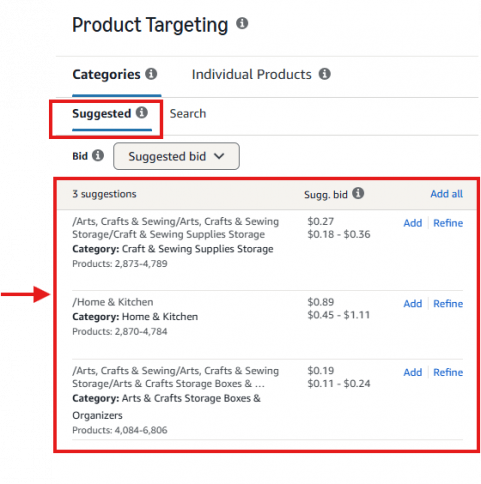
Amazon Suggestions
Amazon can suggest relevant products and categories when you create a campaign.
These suggestions can be a useful starting point, but you should still evaluate whether the products make sense for your goal.
Competitor Research
Look at products shoppers are likely to compare with yours.
Consider:
- Product type
- Features
- Price
- Ratings
- Positioning
- Use case
A useful question is:
Would someone considering this product reasonably consider mine as an alternative?
Campaign Data
Existing campaigns can also reveal product opportunities.
For example, an automatic campaign may surface products that generate useful traffic or sales. You can then decide whether those products deserve more direct control through a manual product-targeting campaign.
For more on that workflow, see our Amazon Automatic vs Manual Campaigns guide.
What Is Negative Targeting?
Targeting also includes deciding where you do not want your ads to compete.
Amazon supports negative targeting for Sponsored Products campaigns.
You may use negative targets when keywords or products repeatedly generate traffic that does not support your campaign goals.
Avoid excluding targets based on too little data.
For a deeper explanation, see our guide on how to find and use Amazon negative keywords.
How Search Terms Help Improve Keyword Targeting
Your targeting choices should improve as you collect data.
The search term report shows how shoppers actually reached your ads.
That data can help you identify:
- Search terms worth adding as keywords
- Keywords that need different match types or bids
- Irrelevant traffic
- Potential negative keywords
- New ways shoppers describe your product
A useful workflow is:
Target → Collect data → Review search terms → Refine targeting → Repeat
This turns targeting from a one-time campaign setup decision into an ongoing learning process.
When Does Targeting Automation Make Sense?
Keyword and product targeting become harder to manage as your campaigns collect more search-term and product-target data.
The challenge is no longer just finding opportunities. You also need to decide:
- Which search terms should become new keyword targets
- Which ASINs are worth adding as product targets
- Which poor-performing keywords should be excluded
- Which product targets should be added as negatives
Doing this manually across many campaigns can take a significant amount of time.
BQool’s AI-Harvesting is designed to automate this part of the targeting workflow. It can discover high-performing keywords and ASIN opportunities, add them as targets, and also add negative keyword or product targets based on performance.
This helps turn campaign data into targeting actions without requiring sellers to review and move every target manually.
Common Amazon PPC Targeting Mistakes
Confusing Targeting With Placement
Keyword targeting is not limited to search results, and product targeting is not limited to product detail pages.
Choose targeting based on what you want to control—not simply where you want the ad to appear.
Adding Too Many Targets Without a Clear Reason
More targets do not automatically create a better campaign.
Each keyword, ASIN, or category should support a clear advertising goal.
Using Only One Targeting Method by Default
Keyword and product targeting solve different targeting jobs.
You do not need to use both in every account, but choose based on the opportunities you want to control rather than habit.
Making Decisions From Too Little Data
Do not treat one click, one order, or one poor result as a complete performance pattern.
Give your targeting enough data to support the decision you are making.
Which Targeting Method Should You Choose?
| If you want to control… | Use |
|---|---|
| Keywords and match types | Keyword targeting |
| Individual products or ASINs | Product targeting |
| Broader groups of products | Category targeting |
| Both keyword and product opportunities | Separate campaigns for each |
There is no single targeting method that is right for every campaign.
Choose the method that gives you control over the opportunities that matter to your advertising goal.
Frequently Asked Questions
What Is Amazon PPC Targeting?
Amazon PPC targeting helps determine which advertising opportunities can make your ad eligible to appear.
For manual Sponsored Products campaigns, advertisers can choose keyword targeting or product targeting.
What Is the Difference Between Keyword and Product Targeting?
Keyword targeting lets you select keywords and match types.
Product targeting lets you select specific products, ASINs, or categories.
The main difference is what you choose as the target—not simply where the ad appears.
Does Keyword Targeting Only Appear in Amazon Search Results?
No. Keyword-targeted Sponsored Products can appear in shopping results and on product detail pages.
Does Product Targeting Only Appear on Product Detail Pages?
No. Product-targeted Sponsored Products can also appear across eligible Sponsored Products placements, including shopping results and product pages.
Can One Sponsored Products Campaign Use Both Keyword and Product Targeting?
No. A manual Sponsored Products campaign uses either keyword targeting or product targeting. If you want to use both, create separate campaigns.
What Are the Three Amazon Keyword Match Types?
Sponsored Products supports:
- Broad
- Phrase
- Exact
These match types control how closely relevant shopper searches need to relate to the keyword you selected.
What Is ASIN Targeting?
ASIN targeting means selecting an individual Amazon product as a product target.
It is part of product targeting, not a separate campaign type.
Can You Target Competitor ASINs?
Yes. You can select relevant competing products as individual product targets when they support your campaign strategy.
What Is the Difference Between a Keyword and a Search Term?
A keyword is what you choose to target.
A search term is what the shopper actually types.
The post Amazon PPC Targeting: Keyword vs Product Targeting appeared first on BQool Blog.
Refused bank account statement
hello im trying to sign up for an individual seller account and they keep refusing my bank statement, i tried the support but don’t get anywhere, anyone else had this problem? I use Swedbank
submitted by /u/Goyimpleb
[link] [comments]
Refused bank account statement
hello im trying to sign up for an individual seller account and they keep refusing my bank statement, i tried the support but don’t get anywhere, anyone else had this problem? I use Swedbank
submitted by /u/Goyimpleb
[link] [comments]
Macau resident wanting to sell on Amazon: Better to set up a company in Hong Kong or Hengqin (Mainland China)?
I’m currently weighing the pros and cons between these two options and would love to get some insights from anyone who has experience with this setup.
Here are a few factors I’m considering:
- Account Approval & Safety: Is Amazon seller account registration smoother or less prone to suspension/verification issues with a Hong Kong company vs. a Mainland Chinese company(Hengqin)?
- Payment & Banking: How easy is it to set up bank accounts or connection to payment gateways (like Payoneer, WorldFirst, PingPong) for both?
- Taxation & Compliance: Which option offers easier accounting, lower tax burden, or more straightforward compliance for a small cross-border seller?
- Logistics & FBA: Does having a Mainland Chinese entity give a significant edge when dealing with suppliers and shipping directly to FBA centers?
If you’ve set up a cross-border entity in either region (especially as a seller from HK/Macau/Taiwan), I’d really appreciate your thoughts or any pitfalls I should avoid. Thanks in advance!
submitted by /u/Crazy_Refuse2089
[link] [comments]
Macau resident wanting to sell on Amazon: Better to set up a company in Hong Kong or Hengqin (Mainland China)?
I’m currently weighing the pros and cons between these two options and would love to get some insights from anyone who has experience with this setup.
Here are a few factors I’m considering:
- Account Approval & Safety: Is Amazon seller account registration smoother or less prone to suspension/verification issues with a Hong Kong company vs. a Mainland Chinese company(Hengqin)?
- Payment & Banking: How easy is it to set up bank accounts or connection to payment gateways (like Payoneer, WorldFirst, PingPong) for both?
- Taxation & Compliance: Which option offers easier accounting, lower tax burden, or more straightforward compliance for a small cross-border seller?
- Logistics & FBA: Does having a Mainland Chinese entity give a significant edge when dealing with suppliers and shipping directly to FBA centers?
If you’ve set up a cross-border entity in either region (especially as a seller from HK/Macau/Taiwan), I’d really appreciate your thoughts or any pitfalls I should avoid. Thanks in advance!
submitted by /u/Crazy_Refuse2089
[link] [comments]
#542 – Ultimate Guide To The New Helium 10 MCP
Audio version above. Video version below
Amazon sellers have access to enormous amounts of valuable data, but turning that information into clear decisions can take hours of filtering, exporting, and spreadsheet work. In this episode, Carrie Miller, Bradley Sutton, Jason McLellan, and Vincent Lan demonstrate how the new Helium 10 MCP connects Amazon data with AI platforms such as Claude and ChatGPT, allowing sellers to analyze their businesses through simple, conversational prompts.
The episode explores practical workflows for Amazon competitor research, keyword ranking, PPC optimization, product research, and listing improvement. Sellers can compare a competitor’s strongest and weakest sales months, identify the keyword-ranking changes that may have influenced performance, uncover valuable keywords they are not tracking, and connect changes in page traffic with historical keyword movement. The Helium 10 MCP can also combine information from Cerebro, Black Box, Search Query Performance, Profits, Keyword Tracker, Brand Analytics, and Helium 10 Ads into one customized report.
Carrie shares how her listing analysis skill compares a product with its competitors, identifies keyword gaps, evaluates listing quality, and prioritizes search terms that may be close enough to page one for a strategic PPC push. Jason reveals how his agency combines Product Opportunity Explorer data with Helium 10 insights to create detailed market intelligence reports, while Vincent explains how he centralizes weekly performance data to understand how changes to pricing, images, rankings, and advertising affect the entire business.
The real power of the Helium 10 MCP is not simply having more data—it is being able to ask better questions and receive an actionable plan in minutes. Sellers who learn how to build effective prompts and reusable AI skills can replace hours of repetitive analysis with faster, smarter decisions. The tools are evolving quickly, but the sellers who begin experimenting now may gain an important advantage in how they research, optimize, and grow their Amazon businesses.
In episode 542 of the AM/PM Podcast, Bradley, Carrie, and Vincent discuss:
- 00:00 – Introduction
- 01:35 – What Is The Helium 10 MCP?
- 03:55 – Connecting Keyword Rankings With Sales Changes
- 07:24 – Building A Market Intelligence Report With Jason McClellan
- 12:18 – Finding Competitors’ Most Consistent Clicked Keywords
- 13:58 – Connecting Helium 10 MCP To Claude And ChatGPT
- 15:56 – Carrie’s Favorite MCP Keyword Opportunity Strategy
- 17:15 – Analyzing Competitor BSR And Historical Rankings
- 20:46 – Finding Valuable Keywords You Are Not Tracking
- 23:06 – MCP Usage Limits And Upcoming Write Capabilities
- 27:47 – Connecting Page Sessions With Keyword Rank Changes
- 31:05 – Using MCP To Improve PPC Campaign Structure
- 35:23 – Tracking Branded Search Volume And Product Opportunities
- 38:39 – Carrie’s Listing And Competitor Analysis Skill
- 42:50 – Combining Helium 10 Tools Into One Weekly Report
- 45:07 – How To Reduce MCP Calls And Use It Efficiently
- 47:19 – Finding Competitor Keywords Worth A PPC Push
- 49:46 – Free Helium 10 MCP Prompts And Skills
Transcript
Carrie Miller:
On today’s episode, we are talking all about the brand-new Helium 10 MCP that connects Helium 10 data to AI tools like Claude and Chat GPT, making it faster and easier than ever to sort through data. Hello everybody, and welcome to the AM/PM podcast. My name is Carrie Miller.
Bradley Sutton:
My name is Bradley Sutton.
Carrie Miller:
This is the show where we discuss all things Amazon, TikTok shop, and Walmart private label.
Bradley Sutton:
And how to generate recurring revenue streams 24 hours a day.
Carrie Miller:
During the AM and the PM.
Bradley Sutton:
Hence, the name of the show, get it?
Carrie Miller:
AM/PM podcast. And as a matter of fact, this weekend, I went up to Lake Tahoe and walked along the Truckee River. And while I was on my walk, I was making money. How cool is that? Pretty cool, I think.
Bradley Sutton:
The thing about this workshop that we’re presenting is whether you fall in either bucket, if you’ve never used MCP before, if you are somebody who is a pro at it, we’re gonna show you different things that maybe you didn’t know you can do with Helium 10. And all of this is design. I mean, the entire premise, guys, of Helium 10 is to help Amazon sellers rise to the top. First of all, did you guys know that’s what the origin of the name Helium 10 means? People ask me that all the time. Like, what is it the carbon number for Helium, the element, the elemental number, or whatever it’s called, periodic table? No, Helium is like a balloon, right? It helps people rise up. And so Helium, we help sellers rise to the top with the best data, 10 out of 10 data, 10 out of 10 service. That’s what we do.
Bradley Sutton:
Okay, so let me, for those of you, just as a recap, let me kind of just like give you a rundown of what MCP means. Basically, it stands for Model Context Protocol, okay? So it’s kind of like, think about it as the bridge between a data center, a service, a software, and you. And you, me, might be using Claude. You might be using ChatGPT. You might be using something else, right? So the Helium 10 MCP, in a nutshell, allows you to take the Helium 10 data that maybe you’ve been using or maybe you’ve never used. Like, there’s some data that maybe you don’t even know existed.
Bradley Sutton:
And then if you are a Claude user or you’re a Codex user, ChatGPT allows you to use the data in your own way instead of being just stuck in the Helium 10 kind of like ecosystem in our dashboards. Like, maybe you want to see the data in a certain way. Maybe you want to search it in a certain way, okay? So that’s basically what we have, all right? But what kind of tools does Helium 10 have on our roadmap for the MCP? We’ve got a lot. You know, our Cerebro functionality, Magnet functionality, Search Query Performance, Brand Analytics, the Profits. We’ve got Listing Builder on the way. Alerts is coming. Helium 10 Ads is already in there. Pretty much most of the Helium 10 tools, at least part of them, part of most of the tools, you know, like maybe not the entire tool or the entire dataset there yet, is going to be accessible via the MCP.
Bradley Sutton:
Now, here’s the thing, guys. For those of you who are new or those of you who are pros, you guys know kind of like what it means when you can start having your own sandbox to play with the data. Let me give you guys a quick scenario here, just to kind of like whet your appetite, and then I’m going to bring an actual Helium 10 customer on, and I don’t know what he’s going to talk about. He’s just had the MCP for a little bit, but he volunteered, said, hey, I want to talk about how I’m using it. But let me just whet your appetite, because this is a prompt just to give you an example of the kind of things you can do. Analyze the BSR chart of these competitor ASINs, and then obviously you would put in like five or six competitor ASINs, and find for each of them the top-selling month in the last 12 months, all right? So basically what I’m telling Claude in this situation is, analyze the BSR chart of these competitor ASINs and find for each of them the top-selling month in the last 12 months. So in other words, maybe I’ve got a coffin shelf, there’s three other coffin shelves out there, and I want Helium 10 to first of all, go tell me when the top-selling months were, okay? And then what was the worst month in the last 12 months? All right, so the best-selling month and the worst-selling month.
Bradley Sutton:
And then I say, use the historical Cerebro functionality to see which keywords were they ranked in the top 10 organic spots, but below rank 30 for the lower month for the same word. All right, let me explain what that means. In other words, I’m saying take the Cerebro time machine. A lot of you guys might not even know there’s a time machine inside of Cerebro. Because Helium 10 is the only tool that can do this. And go back to the best month of when this collagen peptides or whatever was selling, right? And then also go back to the worst month. Where were they ranked? First of all, did you guys know you could do that in Helium 10 right now, even without the MCP? Did you know that you can take a time machine back and see all of the keywords where a product was ranking at any month in the last few years? We’re taking this a step further, right? But basically I’m like hey, show me all the 1,000 keywords or whatever of their best month and the 1,000 keywords that they were ranking for in their worst month and where they were ranking for. And then I say prepare a report for where that product is losing or gaining rank on a certain keyword could have been the reason of the increase or decrease in sales. For example, let me give you an example.
Bradley Sutton:
Let’s say month one is the best month and month two is the worst month. In month one, if they were ranking number four for collagen peptides organically, but then month two in a bad month for that keyword collagen peptides, they were ranked 40th. Well, what does that mean? That means we can kind of attribute that their decrease in sales came from losing rank on this keyword. Does that make sense, guys? Again, regardless if you guys are gonna use MCP or not, this is all inside of Helium 10. This is all data you have available. Maybe you guys have used this. Maybe you haven’t, right? So we are being able to say, hey, what keywords were the reason of why a product increased in sales or decreased in sales? All right, and then taking it a step further, for those keywords, run Cerebro on my own product, and then you would have to put in your ASIN, and tell me where I currently rank for each of them organically, all right? So this is an example. Copy this. You guys can copy this and paste it on your own when you have it, all right? So this is the kind of thing that maybe you wouldn’t even know how to do inside of Helium 10, or it would be very difficult because you would have to run this twice and maybe download it, run some pivot tables in an Excel file, but this would prepare a report. I wanna show you guys, another Helium 10 customer gave his video. Quick four-minute video of how he’s been using the MCP, and then we’re gonna come back with the results of this.
Jason:
Hi, everyone. My name is Jason McClellan with Prime Team Agency, and I’m very excited to be sharing with you one of the things that we are utilizing Helium 10’s MCP server for. If you have not used it, I would highly recommend it. It’s just like being in Helium 10 and using it, except it just becomes a whole lot easier, a lot more conversational style, and you can start pairing it up and utilizing AI to make incredible robust reports. In this case, we’re gonna be taking a look at something that’s near and dear to Bradley’s heart is gonna be the Coffin Shelf. I’m sure everyone watching is very familiar with the Coffin Shelf. We create a report where we look at how products operate in market niches, utilizing Amazon’s Product Opportunity Explorer. If you have not used this in either Amazon, Seller, or Vendor Central, I recommend that you go and you find it under Grow, Product Opportunity Explorer. In this case, we’re gonna be manually taking the data out, putting it in a spreadsheet from Product Opportunity Explorer, and then we’re gonna be matching up the search terms and pulling some additional information out of the MCP server, specifically in Cerebro, and bringing it back to populate into the report. And then from the Products tab, this shows the 95% of the products that are making up the sales in Coffin Shelf.
Jason:
And then we bring in some additional estimated sales through Blackbox, through the MCP server. We saved some time, I went ahead and I just typed in to the cloud environment to give an example where it returns, using Blackbox and Helium 10 MCP, please return the last 30 days of ASIN revenue for the Coffin Shelf that Bradley does. It returns it 916. You can have this come back in any format you want. If you’re doing a lot of it and you want it in a table format, you can tell it in a table format. If you want to integrate into your report, you can integrate into your report. And you can see that 916 right here on the Coffin Shelf is perfect. So we take that in our Claude environment. I have a separate project that we uploaded all, so we can do consistently every time. And then we generate out what I call the market niche intelligence report. In this case, Coffin Shelf, we can see how much total revenue. This is a little skewed because there’s a little bit of click that ends up occurring on floating shelves and floating shelves do a whole lot more volume. So it kind of skews the whole volume on it. But what’s really good is looking at click share. We can see Manny’s Mysterious Oddities at 5.5% click share here, which is really good. And we can see who’s outbidding Bradley on click share. We have some other data that we were able to pull from Opportunity Explorer, AKA OX, about products and how much this year versus last year, see it’s growing competitively. Then we can kind of see key success factors that we’re able to learn from in returns, what the key, 95% of the keywords in that journey that are driving it, where the underlying data that you can see where we’re matching up is the 12-month revenue, 12-month units, subcategory.
Jason:
All this information we’re pulling in from, pulling this in from Blackbox out of Helium 10 to the MCP server to match up into our report. We’re also then pulling in from Cerebro for the 95% of the keywords that are generating the sales on it. We get, we’re able to pull in the estimated CPC number of competing products, the CPR on it. There’s like endless things you can do. Like you can get also Intel Helium 10, give me the keywords that are high volumes that are not, and associated with this, that are not in these keyword search terms that OX is doing for those like mid, marble, and also long tail keywords that you’re long-term gonna want to build your business off of. Once again, my name is Jason. I’m very excited about what we’ve been able to build with Helium 10’s great best of breed third-party data through the MCP server. It’s very simple. Once again, very easy to type in things to retrieve the information. And I hope you can get as much use out of those.
Bradley Sutton:
All right. Here’s another one, guys. That was what Jason came up with. Completely different. You see how he made a custom dashboard? Here’s another one. Here’s a list of competitor ASINs. And obviously you’d put the ASINs in there. Use the Blackbox brand analytics tool to tell me from the weekly reports of the last 26 weeks, so half of a year’s worth of Amazon data, what were the top five keywords where they were most consistently one of the top three products clicked in the last six months? You can only do this with Helium 10, guys. This data is not available in anybody else’s MCP or tool or anything, all right? Do you see the value of this? Like, hey, for your own products, you can use Search Query Performance, right, and see where you’re getting sales from, where you’re one of the top clicked, but you can’t do that in Search Query Performance for your competitors, but with Amazon brand analytics data, you can. So imagine you just put in some of your competitor ASINs and within a couple of minutes, you’re gonna have a full report on this, all right? So Jason from Prime Team Agency, he gave you some of his use cases. I’ve given you guys already a couple of use cases. This is just to kind of get your imagination going. Hey, I’ve got Helium 10, how do I install the MCP? Well, you just go to Claude and you go to the Customize and then hit Connectors and enter Helium 10 in there. Helium 10 is in the Claude official directory. It’s one of the few ones that are approved by Claude. You can just install it right there. You need to be logged into your Helium 10 account. And yes, you have to have the Diamond account. And for some of these like ABA tool, you have to have brand registry. That’s not a Helium 10 requirement, that’s an Amazon requirement how you have to have brand registry.
Bradley Sutton:
So like if you don’t have brand registry, you’re not gonna be able to use brand analytics. You won’t be able to use Search Query Performance. If you don’t have your Amazon account connected to Helium 10, you’re not gonna be able to look up your own Profits and things like that. Leslie’s asking here, I told everybody how to install the MCP in Claude, how can Leslie do it in ChatGPT? For those of you with ChatGPT and not Claude, you have the answer right here. You go to Codex app, open Codex, go to Settings, open MCP servers, click Add Your Own, Add Server, or connect to a custom MCP. For the server type, choose Streamable HTTP, enter the server details. The name is Helium 10 MCP. And then the URL, you guys will have to watch this on YouTube, those of you who are just listening to this on the podcast, you can get it there. As you can see, it’s a little bit easier to do with Claude. Let me pull up Carrie to the screen. What is your favorite thing that you have done for your own brands with the MCP so far?
Carrie Miller:
I actually, I’ve done a lot of different things, but I think the best thing that I did, and I actually shared this skill, it’s in the listing analyzer skill, but it basically compares you to your competitors. And it shows you keywords where you can, you’re pretty close to page one, where you can really push. Because that’s kind of something that was hard to sort through manually, is figuring out all the keywords where you’re kind of close, where your competitors are also ranking really high, probably in the top 10, and they’re getting a lot of sales from that. And so I have a list now of keywords that I can push with PPC to start ranking for those keywords. So that was one of my favorite things to do. But I just think, in general, I can sort through the data so much faster, and two things that I just wasn’t able to do before. And that’s what’s really exciting, just like this, is just kind of figuring out, okay, what are the strategies I can use to push sales and just increase my presence all over Amazon?
Bradley Sutton:
Yep, yep. Why don’t you throw, I still, can you throw up your Claude?
Carrie Miller:
Yes.
Bradley Sutton:
Here, and then I’ll be able to share it. And then scroll back to when you first just entered it, so we can kind of like walk through the process of what you did here. And guys, we’re doing this on the fly. I don’t even know what ASINs you picked. We didn’t prepare this. We want to show you that, hey, this is not something that, oh, we gotta do it 17 times to get it right. We just picked some random ASINs. Okay, so she copied and pasted right there, analyzed the BSR chart. And then you put, it looks like three ASINs, and those are collagen peptides ASINs, right?
Carrie Miller:
Yep.
Bradley Sutton:
Okay, vital proteins, that’s a very famous one. And so their high month was October, but they had a low month in July. Okay, very good. And then what’s this next part here that it’s saying? Top ranked, top 10 in the high month dropped. Look at this, guys. Guys, look at this. This is great stuff here. Look at this keyword, protein water mix. First of all, I wouldn’t even have known that that’s a relevant keyword to collagen peptides, but it’s a search for a thousand times. It went from ranked number five to unranked. Do you think that resulted in a drop of sales, guys? You better believe it. Look at the other keyword here. Here’s a keyword, muscle recovery supplements. Again, I might not have known that that’s very relevant to collagen peptides. 1,500 searches. It was ranked number three in a great month, but then, oh, what a coincidence. In the low sales month, it got ranked 166. Could this have been one of the reasons that their sales went down a little bit? You better believe it. Here’s, oh man, this ancient nutrition has got some that are even more, that are more evident. Here is a 10,000 search volume keyword. It’s a more generic keyword, protein shake. Most people don’t think collagen is protein, but some people use collagen for their protein shake, and it’s a 10,000 search volume keyword. They were in the top 10 on their high month, and their low month, look what happened, 147. So this is just data by itself, guys.
Bradley Sutton:
What do you do with this data? If I had collagen peptides, and I look at this, number one, I’m like, okay, first of all, maybe I wasn’t even targeting protein shake powder. That was actually the step three. I’m not sure if Carrie actually did. I told her to stop, but maybe she didn’t do it. That’s, okay, that’s actually the step three, where let’s say I had my own collagen peptides, and maybe I’m not even ranking for protein shake powder at all. Well, now it’s like, oh, I better start targeting this, because if this ancient nutrition can get sales, and it’s obviously an important keyword for them, because it was the reason that they were getting higher sales in one month compared to the next, then I better maintain my rank. What if it’s a keyword I’m already ranking for? Ooh, this collagen peptides capsules, I’m already actually ranking better than sports research. I’m number eight, and as you can see here, they’re number 10. Well, when I look at this data, and I see that, hey, when sports research dropped their rank for that keyword, their sales went down, what does that mean for me? If I have collagen peptides, what I’m gonna be doing is I’m gonna be protecting my rank more for that keyword. I wanna maybe push that in advertising. So you see, at the end of the day, data is just data. We can come up with all kinds of fancy data, but it’s useless if you don’t actually take action on it.
Bradley Sutton:
So these skills, this one is not a skill, this one is just a literal prompt that you guys can just copy, but when you start using the skills that I created, or that Carrie has created, or that you guys create on your own, make sure at the end of it, there is an action, okay? Otherwise, it’s just you’re doing window shopping of fancy data. Ooh, that’s nice, that’s nice. And what good does it do you unless you go in the store and actually buy it, right? So that’s what I want you guys to do. But here, this was, Carrie had no idea she was even gonna do this, and she was able to pull some stuff up from a niche. All right, here’s another one. Take a picture of this, guys. You can run this. Run my ASIN in Cerebro. Obviously, you would put your ASIN in there. Tell me which keywords I’m organically ranked in the top 10 that have more than 500 search volume, but I’m not currently tracking in Keyword Tracker, and give me a list of them so I can copy and paste to Keyword Tracker. This is taking two Helium 10 tools and putting it together. Now, this is a super simple one, like three lines, four lines of text, but what’s the value in this? What happens sometimes is you might start ranking for keywords.
Bradley Sutton:
I don’t wanna use the word by accident, but maybe Amazon was showing you for some auto campaigns that you didn’t even know you were converting, or maybe just Amazon throws you on page one for a keyword randomly, and you start getting sales from it. Well, what does that mean? You’re gonna start ranking organically, consistently for that keyword, so you should be tracking your good keywords, and so you have a set of 20, 30 keywords that you know are important to you, and you wanna make sure you’re on page one or track your progress to page one, but what happens is sometimes, like I said, you start getting sales from keywords you didn’t even know were relevant, and you’re ranking for these keywords, and if you don’t know, if you’re not tracking it, they just as easily as you got on page one, if it’s not even on your radar, you could fall off of page one if you take the foot off the gas, right? So this is a prompt that allows you to identify all the keywords that have decent search volume that you’re ranking highly for in the last 30 days, and you didn’t even realize it. Now, you can put them in Keyword Tracker and start making a conscientious effort to track those keywords. Does this one make sense, Carrie? You’ve never seen this one before.
Carrie Miller:
No, I haven’t seen this one before. I definitely wanna run it.
Bradley Sutton:
Have you done this manually before, where you’ve run Cerebro, and you’re like, what in the world? I’m ranking for this keyword, and then like, oh, yeah, so maybe you’ve done this one manually, right? So how would you do this manually? What’s the whole process without MCP?
Carrie Miller:
So basically, I mean, what I’ve seen is that I’ve kinda sorted with the Cerebro search results where I’m in the top 10. So I filter where I’m at, spot one to 10, and I’m like, oh, there’s all the keywords. So you can see where your sponsored rank is and where you’re organic, and you can filter that with the Cerebro filters.
Bradley Sutton:
How many calls does it cost for one prompt for daily reports? Are you talking about how we have a monthly limit of 1,000, or are you talking about your own Claude tokens? Your own Claude tokens, we don’t have no idea. It depends how crazy the prompt is that you put in there. But if you’re talking about the 1,000 uses that you get with Helium 10, basically how that’s counted, it doesn’t matter how crazy the prompt is or how easy the prompt is. If you make a call to a tool like, hey, run Cerebro and give me the output of all the keywords where this product’s ranking for, it could return 8,000 keywords. It could return five keywords. That’s one call out of your 1,000 a month that you can use.
Bradley Sutton:
Arne says, will we be able to set up tracking keyword rank competitor ASINs through MCP? So yes, eventually. You’re talking about kind of like write capabilities, not R-I-G-H-T-W-R-I-T. So right now, the MCP is mainly like read. So we allow you to pull in the data, but we don’t allow you to write or push it back. But yes, eventually, now you’re gonna be like, remember that one tool, that one prompt I just showed you guys? Let me pull it back on the screen. Remember this one where it says here at the end, give me a list of the keywords that I can copy and paste in the keyword tracker. So I think this is exactly what Arne, you’re talking about within a few weeks or I don’t know when. You know, Vincent might get mad at me if I give you guys an exact date. But you’re gonna be able to say, all right, now add these keywords to my keyword tracker.
Bradley Sutton:
I’m gonna go ahead and put Vincent on the spot here. Let me bring him up. For Vincent, for what I just said, when will something like that be available?
Vincent:
It will be in the middle of August.
Bradley Sutton:
Oh, wow, so less than a month, less than a month away. Okay, thank you for that, Vincent. Gonzalo says, can we see the value of it first instead of getting it connected? Well, first of all, guys, the MCP is free. Well, like if you have a Helium 10 Diamond account, you have it. It’s not like, oh, I have to commit to something crazy. Now, if you guys have a Platinum account or you don’t have Helium 10 and you’re wondering, should I get the Diamond account for this? Well, that’s kind of what this workshop is for, just to kind of show you all of the potential. And we’re just scratching the surface, guys. Rarely is there a tool that we release where it’s limitless potential. We release Cerebro. It does a few things very good and it’s the most amazing tool out there. But we could have a two-hour workshop and probably cover all the main things that it does. We could be here for like 24 hours and not finish everything that you could do because it’s literally infinite because you’re the one prompting it.
Bradley Sutton:
You’re not constrained by like a UI of filters or you’re not constrained by entry points in Helium 10. Whatever you want to ask Claude or chatGPT, that’s what the MCP can do. So really you decide, Gonzalo, you’re like what the value is because it’s based on whatever your imagination comes up. And that’s why I’ve been giving you guys these little prompts to kind of stir your imagination on the kind of things that you can do. Like this is not meant to reinvent the wheel. Like some of these things maybe you never did because it would take so long. But a lot of this stuff, hopefully you were already doing in Helium 10. But instead of it taking 15 minutes, now it can take either one minute or you just turn it on in the background and then have Claude give you a daily report on your keyword ranks and things like that.
Carrie Miller:
Can I add something to that?
Bradley Sutton:
Sure.
Carrie Miller:
I think a lot of people don’t even realize how many capabilities are in Helium 10 and some people might get overwhelmed with it. But with the MCP, you can just ask it, hey, can I do this through the Helium 10 MCP? And usually it’s yes. And you can pull in that data without having to be an expert in all the Helium 10 tools. So you’re basically getting access to way more things faster than you even knew were available through Helium 10.
Bradley Sutton:
Troy says, hey, better to put this in co-work rather than chat and upgrade the model, you can get better results. Absolutely, guys. Claude, if you’re trying to use the cheapest form of Claude because you’re trying to save your tokens, you’re actually gonna have a worse experience and it might start hallucinating even some Helium 10 data and stuff. So you gotta be careful. The very minimum I use is like, yeah, the very minimum is Sonnet medium. And even that is kind of like, nah, I probably should go a little bit more, like maybe even use Opus. But yeah, the data, the Helium 10 data is solid. But what happens if you start going cheap on Claude, it might like start hallucinating or maybe like make up some stuff. So just be careful, be careful with that or might get confused and might not know how to do stuff.
Bradley Sutton:
You guys ready for another prompt? Okay, here we go. Analyze the keywords I’m tracking for and then put the ASIN in. Analyze my page sessions. This is from business reports, right? That’s from Seller Central. We have that in Helium 10 Profits. Analyze my page sessions. In other words, how many people have visited my page for the last five months and the keyword ranks for five months. Looking at it at a weekly basis. All right, guys, we’re already going like seven levels beyond what you could possibly do with a human eye in Keyword Tracker. We’re doing data that’s in Keyword Tracker, but like from the very first line, you’ve already lost any human, like they would never be able to do this. Give me a report on what keywords might have caused increases or decreases in my page sessions due to my keyword rank for the week shooting up or falling down.
Bradley Sutton:
So in other words, if you guys are the kind of people who looks at your business reports all the time, like week to week and you look at your page sessions, ooh, I had 7,500 page sessions. I mean 7,500 people clicked your product from like search results or ads and they viewed your product, right? But then the very next week you had 4,400, right? Sometimes it’s just because, hey, there’s less customers. Like obviously everybody’s page sessions was blowing up during prime week. Has nothing to do with keyword ranks or anything, right? But sometimes what if the number of customers are the same, but your page sessions went down? What could this be an indication of? It could be an indication that you have lost keyword rank on some keywords that were bringing you a lot of traffic before. And so you wanna know which keywords it was? Historically, what would you do? You would first look at profits. You would see a drop in sessions. Now you go to that product and keyword tracker and maybe you’re tracking 75 keywords and one by one you’re clicking on that graph and seeing, hey, where did I drop? Ooh, here’s, I found a keyword where I dropped from five to 20. There’s where one of my session problems is. That would take you an hour to do. Claude is gonna do this, or ChatGPT, with a Helium 10 MCP in like two minutes, all right? So there’s another one that you guys can save and run on your own.
Bradley Sutton:
Russell says, can I ask before loads of effort is spent on getting this working, if you’re on Platinum, does this actually work? If you’re asking, can you use this on the Platinum plan? No, all of our AI functionalities are for the Diamond plan, for, you know, like the Platinum is for like, you’re a brand new seller. You’ve got one product. That’s who should be on the Platinum plan. So you probably don’t need to use the MCP. I’ll be honest, I’m not trying to take your money if you don’t have a need for something. If you’re a brand new seller on the Platinum plan, you’ve got like one or two products, you can take the time to do this stuff in Keyword Tracker. You know, what I just said probably doesn’t take you that long. If you’re a newer seller, maybe you’re only tracking 10 keywords. You could have done that in like three or four minutes. So the MCP is probably only gonna save you like 10 minutes there, or five minutes. Is that worth, you know, the price of Diamond? Probably not. But for anybody who’s got, you know, more than one product, hopefully you’re on the Diamond plan. Yeah, definitely is worth it. I think we can show you how important it is.
Bradley Sutton:
We need MCP PPC use case. Okay, it says, look here at my advertising or look at all of my advertising campaigns that I have active that have a keyword or ASIN targets. You know, so in other words, not like auto campaigns or random audience targeting, sponsor display campaigns and stuff like that. And give me the list of campaigns that have more than 15 active targets, right? Like maybe you had some kind of automation going on where you’re finding keywords from your auto and broad campaigns and putting it into your manual campaigns. But maybe you personally like to keep 15 targets. I think Vincent like does single campaign or Vincent might only do five targets for some of his campaigns.
Bradley Sutton:
But everybody has a different number. Some people are like, hey, I just wanna have 50 targets. I just wanna have 10, I wanna have five. Well, if you were just blindly adding targets, maybe you have some campaigns that have like 60 targets and you didn’t realize it. And what’s gonna happen if you have 60 targets in a campaign that doesn’t have enough budget? Not all of those targets are gonna get impressions. And so what should you do regardless of MCP or any software or anything? Well, no, you should be taking out the low impression ones and putting it in a new campaign to give it room to breathe, right? So what I would do manually is like, all right, let me look at my campaign. Ooh, this one has 20. Let me take the five targets that have the lowest number of impressions and let me extract it and put it in a separate campaign. This is what this prompt does. It allows you to look at all the campaigns. It tells you which ones has increased over your limit. And obviously you guys would change your number here if it was five or if it was 10 or whatever. And then it would tell you which keywords to pull out and put in a separate campaign or ASINs. All right, so there’s a PPC one.
Bradley Sutton
Okay, good question. I’m gonna bring Vincent up for this one. So Lori says, sub-users on our Diamond account are not able to authorize the connector. Only the primary account has been granted access. Sub-users are prompted for plan upgrade. No, obviously the sub-users don’t need to upgrade the plan, but how can the sub-users leverage the MCP as well, Vincent?
Vincent:
So make sure the main account, which is the primary account, turn on the MCP for the sub-users and also for each function, for example, Cerebro, SQP, all the functions need to turn on. If part of the tool is turned on, which means a part of the MCP function will be able to use.
Bradley Sutton:
So it’s like when you create the sub-users, you have that page with the authorizations.
Vincent:
Yeah, the checkbox.
Bradley Sutton:
The permissions that you guys, oh, let me give this sub-user Cerebro, let me give this sub-user Listing Analyzer. Well, there’s one now for the MCP, guys. And so you have to go to your authorization page, or what’s it called? What’s it actually called in the menu?
Carrie Miller:
It’s account permissions, I believe.
Bradley Sutton:
Account permissions, account permissions. And then go to your sub-users and then just make sure that each of them are granted access to the MCP. Thank you for that, Vincent. Is there a prompt to easily track branded search form? Absolutely, I’m just gonna make it up from the top of my head right now. You ready? I don’t have this written down in my slide deck. What I would say for this is, please create a list of keywords that have my brand name in it, or a version of my brand name, and tell me what is the total search volume. And you would make this a skill where every month you would run this and it would show you a new chart, or a new date in the chart of what the new search volume is. And you could go back in history and look, hey, last year my branded searches were 75,000 search volume. So what the MCP would be doing would be entering variations of your brand name into Cerebro for keywords, which is the artist formerly known as Magnet, and then adding up the search volume. So this is nothing that you can’t do right now just on the regular Helium 10.
Bradley Sutton:
It’d just be really hard to do it, and very tedious to do it. But I just came up with something, and that’s the beauty about MCPs, guys, is you come up with things in natural language, and literally I just talk to you guys verbally. That’s how you should do it with Claude, too. I mean, I obviously have slides here so you guys can copy some of my prompts, but turn the microphone on Claude and just talk to it. Explain what you want from Helium 10 in just natural language. And stuff that maybe you didn’t even think was possible because you didn’t know how to use the filter in Helium 10, you can just use natural language and find it. You know what? Let’s go ahead and do another example. Oh, here’s a product research one. Okay, here we go. I’m selling spooky products such as coffin shelves, bat-shaped bath mats, et cetera, in the home and kitchen category. Use Black Box keywords to find keywords that are related to my spooky niche that have at least 1,000 search volume, but a title density. Title density, this is something that no other tool has, and no other tool has this database of Amazon keywords like this.
Bradley Sutton:
A title density of less than 10 where at least five out of the top 10 results, this is another function that nobody else has, guys, I don’t care who has an MCP, who has a tool, nobody has this, where at least five out of the top 10 results on the page have less than 200 reviews. That’s crazy, guys. It’s just gonna know, Claude is gonna know, oh, let me look for some coffin-related keywords, let me look for any gothic decor-related keywords, and oh, it has 1,000 search volume. Oh, this one, the top 10 results, there’s half of them have less than 200 reviews, and it’s gonna give me that report. So you guys would, I mean, obviously you’re not gonna copy this whole thing because I don’t know how many of you guys are selling spooky products, but what you would do is you would change it to your niche. Carrie has a skateboard business, so she would be like, hey, I’m looking for this new kind of skateboard or something like that.
Bradley Sutton:
Vincent sells a lot of cool products in electronics category, too, so he would be entering some electronics stuff. By the way, Vincent, how can Vincent come up with this kind of stuff? Well, Vincent is also an Amazon seller as well. I think six, seven figures, maybe?
Carrie Miller:
So I actually created a listing analysis skill, and basically what it does is it compares you to your competitors and then shows you kind of where they put their keywords compared to yourself, where keywords where you’re missing and they’re beating you quite badly. So I actually ran this for likings. I’ve done it for my own brand. It was really helpful because I was able to see the keyword coverage in how they’re beating me and then suggestions on how to improve.
Bradley Sutton:
So guys, for those who are new to MCPs and Claude and stuff, what I was showing you is a prompt. A skill, it’s already a pre-programmed thing. We wrote something and programmed it all and vetted it out and made it the perfect prompt. And so then all you do, you add this skill to Claude, you download it, you add it to your own Claude, and then you just say, hey, run Carrie’s skill on this ASIN. Instead of having to write paragraphs and paragraphs of all the parameters and what tool to do, you just enter, hey, use Carrie’s skill. I’m gonna answer a quick question from Dylan says, is this more valuable to brand owners and resellers or equally as valuable? Equally as valuable. I mean, if you’re already using Helium 10, you must have a reason for using Helium 10. If you’re a reseller, it’s mainly about your profitability and your page sessions. And perhaps, I don’t know if you’re running advertising or you’re running, you get a wholesale list from a supplier and you go into Black Box and you wanna find out what are the top 400 selling products under this brand and let me enter in this price list and which ones are profitable. You can do that in seconds now with the MCP. Like here’s a price list that I just got from this supplier. Tell me the profitability on it.
Bradley Sutton:
Which ones am I gonna have the most profit margins and which ones sell the most on Amazon? It’s gonna pull in data from Black Box, et cetera. So yeah, I think that if you’re a reseller, you can find value, especially if you’re using Helium 10.
Carrie Miller:
So the first thing it’s gonna give you is an analysis on where your keywords are compared to your competitors, where you’re ranking and what keywords you’re doing well on or what strategies you’re doing well on. And then it gives you kind of a score. It’s like the number of keywords ranked. It looks like your competition is beating you on the number of keywords ranked here. But page one keywords looks like you’re winning right here. So it tells you, okay, you’re winning on page one keywords against competition. Listing quality score looks like you need to improve your listings. That’s an indication, okay, you need to make some improvements based on the comparison to your competitors. Price, you’re gonna compare to your competitors that way. Number of reviews, your competition’s beating you. So it gives you kind of a lot of details and then it tells you why the competition might be winning the sale. Maybe they have some better features. Maybe they have better reviews.
Carrie Miller:
It’s gonna analyze that and it’s gonna give you why they’re winning the sale. Maybe it can give you some ideas for improvements for the product. You know, maybe like for example, like this one, maybe the Lees leggings have pockets and yours don’t. You know, that might be something to add. So it’s gonna give you some suggestions on that. It’s gonna tell you where you’re ahead. And then it’s gonna also give you some suggested bullets that you can, and title and bullets basically. Now, obviously you don’t necessarily have to take this word for word, but I usually like this suggestion and I can kind of combine it with maybe what I’ve already done. And it gives just a really good starting place. I mean, it also kind of gives you some disclaimers too. If it’s like, hey, you know, like for example, it says the seed title doesn’t mention pockets or all these things, but you know, the other competitors are, so we put it in there. So you don’t, you know, depending on what your product is, you can make that judgment. And then, you know, new selling point ideas, it’s not in your current listing. So, you know, those are kind of ideas that maybe you should consider adding. And then it gives you a prioritized action plan on this. So I love that it gives you kind of a step-by-step checklist of what to do. So there’s that one.
Bradley Sutton:
Let me get back to my questions here. I wanna bring Vincent on really quick here from a different angle. Vincent, we just mentioned you’re a very successful Amazon seller. Now, what has been your favorite thing that you have done with the Helium 10 MCP for your own Amazon business? Not like trying to test stuff to make sure, just make sure it doesn’t break and stuff, but like you actually use it for your own business.
Vincent:
Okay, what a good question. I think when I try to use the Helium 10 in the website, I need to play around so many tools, one by one to get the report, especially when I’m doing the weekly report. This is super difficult. So what I’m doing right now is combining Cerebo with Profit, with the SQP, with Keyword Tracker, with the PPC. So I just pulling all the data. If I doing any update, for example, the alerts will tell me, now if I change my price, if I change my image, if my session get an impact, or if my ads is going to get impact. So all of those data will be all in one instead of I go to each tools to play around. So compared to the past, I think it’s totally different world. It’s hard to see over all pictures at once, right? Otherwise you have to go to each tool, then digging into what’s going on with my product. But right now you can have everything in centralized see in one page. And AI can help you to analyze, maybe something is going to happen in one day. You take some action on that and impact your PPC campaign or whatever. So it will be the much better, smooth experience compared to the past. This is why I use every week.
Vincent:
Yeah, so again, this is Vincent, not as the product manager of Helium 10, but as an Amazon seller. Like all three of us, if we weren’t working at Helium 10, obviously we get free Helium 10 guys, nanny nanny boo boo to all you guys who have to pay, we get it free. But guess what? If for some reason we were to decide, you know what, we’re going to retire from Helium 10 and just run our Amazon business, I would instantly pay for this as a Amazon seller. This stuff is just valuable. So thank you for that, Vincent. I want to highlight this. Make sure that you optimize how the MCP is running. For example, if you just said, hey, run Cerebro without context on these 100 ASINs without specifying how to do it, it could be running Cerebro 100 times and that’s going to be 100 calls. But what you should start doing is make other statements like, hey, combine these 20 ASINs into one Cerebro search. So you just took 20 and then made it one, all right? When you’re looking at brand analytics, 26 weeks, don’t say go download 26 weeks one by one. Hey, say, hey, enter it in and just download everything at once. Now it’s only one call. But there’s some power users out there, you know, who run a lot of brands and are running into that 1000 limit.
Vincent:
So don’t worry guys, we’re going to come up with something where we can figure out how to, you know, increase the limits on this. Daniel says, Claude told me I cannot pull ads data because I’ve turned my profile to analytics only. Yes, so the ones who can do the PPC data is you have to be using, having the Helium 10 ads on full and then you’d be able to go ahead and utilize that. Ricardo says, can you put the Platinum plan seven day free trial for like MCP? I don’t know, maybe we can think of something like that. But why don’t you just try it for one month? Take down this code guys, SSP30. SSP30, it’ll save you 30% off the Diamond plan for one month or up to six months, but try it for one month. When I say up to six months, it doesn’t mean, oh, if you use code SSP30, then you’re stuck with Helium 10 diamond plan for six months, no. Run it for one. So that’s like getting like 70 bucks off the diamond plan. Run it for a month, guys. First of all, you’re gonna more than get your money’s worth even without the MCP on a diamond plan because you’ve never run the search query performance, you’ve never run brand analytics, you’ve never run historical Cerebro and all these other things that the diamond plan has. So it’s instantly gonna pay for itself, but then use that one month as kind of like a free trial with the MCP. That’s what I would do.
Carrie Miller:
Okay, this is my favorite part. It’s the top 50 relevant keywords your competitors are beating you on, okay? So it shows the actual keywords, right? So yoga pants, for example, your competitor rank is four and my organic rank is 149. Well, that’s kind of close. It’s not too, too far away from page one. So I can push that with PPC. So something that actually for some reason is not on here, but I actually also have with the skill that you’ll download, you’ll have the CPR number here. I think this is before I completely optimize the skill, but you’ll have the CPR number here, which is the number of sales that you need to get in order to rank to the top 10. So you’ll be able to see the exact number of sales and what the PPC push is gonna be for each keyword. And then it’ll show you like, hey, you’re not ranking. And then if a keyword is like kind of buried, like it’s 282, it’s gonna be in red and it’s gonna say, hey, don’t push this one right now. So basically you can go in and prioritize the keywords where you’re kind of close. Like this one is you’re 76, okay? Your competitor is five, women’s leggings. That’s definitely a relevant keyword. It’s an important keyword where you’ll probably get a lot of sales if you rank it to the top 10.
Carrie Miller:
So you’ll take that CPR number that we have in Helium 10 and that’s the number of sales you need to get over a span of eight days in order to get to the top 10. So you’ll just need to push those PPC sales for those days to see your rank move. And obviously you’re gonna wanna be tracking this in Keyword Tracker with those specific keywords that you are trying to push. But this is really important because it’s the top 50. And I noticed with my own competitor that they have a lot of keyword reach and span, but there’s specific keywords where they’re getting a lot of the sales and that I’m kind of close. And if I were to just push a little bit, then that could be a huge, a major change in my sales. So that is the next part of that, the skill. There’s actually more in there, but I’ll go ahead and stop there. It is so, so helpful and something that I have used already, so.
Bradley Sutton:
Awesome. What data does Helium 10 import from Amazon? Tons of that. I mean, most of the data we have originally comes from Amazon, like all your advertising, your profits data, anything that’s tied to your token. That’s why we have you connect your Amazon account to Helium 10 so that we can have that. Amalia says, any considerations around data security when having your seller account connected to Helium 10 and Helium 10 connected to Claude? Not necessarily, no. But if you’re one of those people who are like scared that Claude and ChatGPT and these things are like big brother watching you, there’s some like just general security things and guidelines like that. There’s prompts that you can do, like this has nothing to do with Helium 10, but I would recommend do your due diligence just in general, whenever you’re using AI, if you’re worried about, hey, is Claude or ChatGPT gonna use my data to train models or are they gonna share the data? If you’re not sure about what Claude can and can’t do, do some research on that. But if you’re worried about like, oh, is there some kind of flag that Amazon is going to do because I’m using MCP through Helium 10 to my account? No, like the data, I mean, Helium 10 already has the data. You’re pinging Helium 10, you’re not pinging Amazon. And it’s not like, oh, now you’re open up to anybody who’s ever used Claude or something like that is gonna be tied to your account. No, that’s not gonna happen. Okay, so guys, what I’m gonna do is I’m gonna have three packets for you.
Bradley Sutton:
One is three of my skills that I use, kind of like what Carrie was doing. I didn’t show you guys any of my skills today. I was showing you guys prompts today. So one is three of my skills. One, it really helps with Amazon advertising and knowing what you can do for phrase campaigns. The other one is a great search query performance skill. Analyzes some really good search query performance. Number two, I’m gonna give you Carrie’s skill. And maybe another one, I’m gonna have her work on another one so that she can give two skills to you. And then number three, all of the prompts I gave, plus I didn’t have time to do five more prompts that I prepared, a packet of prompts. So how you can get all three, all right? This is gonna be like an Instagram treasure hunt, kind of, all right? There’s three Instagram accounts I need you to follow. Number one, Helium 10. Number two, AM/PM podcast. It might just say AM, PM podcast, I don’t know. You’ll see it. And number three, Serious Sellers podcast. What you’re gonna do on the Helium 10 one is type MCP as a comment on one of the last, don’t do everything on the last video or reel, but the one that’s, any reel that you see that’s about the MCP. Type in MCP for me, all right? MCP for me on Helium 10.
Bradley Sutton:
On AM, PM podcast, go to any of the recent reels in the last week or so, maybe a Weekly Buzz one or another one, and type in, I want Carrie’s skills. Okay, I want Carrie’s skills for AM/PM podcast. And if you don’t get the exact prompt right, that’s fine. If you’re just posting something else that’s close to it, we’ll know what you want and we’ll DM you the link. And the third one, Serious Sellers podcast. Make sure to follow it. Go to any of the recent videos and type in, I want Bradley’s skills, okay? So each of those, if you just do one, we’ll just send you whatever that one was. And you won’t know which one it’s gonna be except if it’s the Carrie and Bradley one, right? But if you do all three, we’ll slide into those DMs or give you the link so you can download all of these in one link and you’ll have it all. So they’re, like I said, completely free. I just want you guys to go on a little treasure map because I’m doing some Instagram checking. But thank you guys. Helium 10 software, somebody said. Helium 10 software, Serious Sellers podcast and AM, PM podcast. You have to be liking, or you have to like and follow as well, right? So make sure you’re following. We’ll check to make sure that you’re following.
Bradley Sutton:
And there you have it. All right, guys, thank you, Carrie. Thank you, Vincent. Thank you, Jason. In the background, I’m gonna leave this with one last comment that Spencer, who was supposed to come on here, but he had to hop off for a meeting. My job might let me go if they knew how much this AI MCP is helping with it. So in other words, he’s afraid of losing his job if they find out that the MCP is actually doing all this work that they probably think it takes him hours and hours to do and he’s able to do it in minutes. All right, so that’s how I want you guys to be feeling because you’re using it so much that you’re like, oh man, if you’ve got a boss or somebody who’s the owner of the brand, that you’re like, oh man, maybe they’re gonna think that they don’t need me anymore because this MCP is so amazing. That’s what I want you guys to almost feel like. I don’t want you guys to lose your job, of course. That’s why you have to be, you’ll be the expert in MCP and then you’ll be so valuable to your boss that they’ll never be able to fire you thanks to the Helium 10 MCP. All right, guys, thank you so much.
Bradley Sutton:
We’ll see you next time. Bye-bye.
Enjoy this episode? Want to be able to ask questions to Leo Sgovio live in a small group with other 7 and 8-figure Amazon sellers? Join the Helium 10 Elite Mastermind and get quarterly workshops, monthly training, and networking calls with Leo at h10.me/elite
Make sure to subscribe to the podcast on iTunes, Spotify, or wherever you listen to our podcast!
💰 Get Helium 10 with a special discount to start or scale your e-commerce business here: https://h10.me/h10
Want to absolutely start crushing it on eCommerce and make more money? Follow these steps for helpful resources to get started:
- Get the Ultimate Resource Guide from Bradley Sutton, Carrie Miller, and Shivali Patel for tools and services that he uses every day to dominate on Amazon!
- New to Selling on Amazon? Freedom Ticket offers the best tips, tricks, and strategies for beginners just starting out! Sign up for Freedom Ticket.
- Trying to Find a New Product? Get the most powerful Amazon product research tool in Black Box, available only at Helium 10! Start researching with Black Box.
- Want to Verify Your Product Idea? Use Xray in our Chrome extension to check how lucrative your next product idea is with over a dozen metrics of data! Download the Helium 10 Chrome Extension.
- The Ultimate Software Tool Suite for Amazon Sellers! Get more Helium 10 tools that can help you optimize your listings and increase sales for a low price! Sign up today!
- Does Amazon Owe YOU Money? Find Out for FREE! If you have been selling for over a year on Amazon, you may be owed money for lost or damaged inventory and not even know it. Get a FREE refund report to see how much you’re owed!
- Check out our other Amazon FBA podcasts including the Serious Sellers Podcast.
- You can also listen to the AM/PM Podcast on YouTube here!

The post #542 – Ultimate Guide To The New Helium 10 MCP appeared first on AM/PM Podcast.

