
I have to use incognito mode to be able to sing-in – why?
When I try to log into Amazon, after entering correct email and password (auto-loaded from Chrome), I get a red-color error saying “Your accounts did not load. Please try again.”
But when I use an incognito mode in Chrome, I can normally sign-in. After entering my email and password (again auto-loaded from Chrome), I just get a selection of accounts (around 20) to which I want to log in and after I select an account, I am in.
Does anyone know how to fix this, so that I can sign-in normally and not through an incognito mode?
Thank you
submitted by /u/heruka108
[link] [comments]
I have to use incognito mode to be able to sing-in – why?
When I try to log into Amazon, after entering correct email and password (auto-loaded from Chrome), I get a red-color error saying “Your accounts did not load. Please try again.”
But when I use an incognito mode in Chrome, I can normally sign-in. After entering my email and password (again auto-loaded from Chrome), I just get a selection of accounts (around 20) to which I want to log in and after I select an account, I am in.
Does anyone know how to fix this, so that I can sign-in normally and not through an incognito mode?
Thank you
submitted by /u/heruka108
[link] [comments]
When Is Amazon Peak Season? Key Dates in 2026
Amazon peak season runs from October through December, with the highest sales happening around Black Friday, Cyber Monday, and the Christmas shopping period.
For many sellers, this is the most important time of the year. According to Meteorspace, over 30% of annual eCommerce sales happen during Q4, driven by holiday shopping and major promotional events.
But peak season is not just a few busy days. It is a longer cycle that builds over time. Events like Prime Day in July give sellers a chance to test what works before demand increases.
Sellers who prepare early are more likely to succeed, because they are ready when both traffic and competition rise.
Overview
When Is Amazon Peak Season?
- Peak season: October to December
- Busiest shopping periods: Black Friday, Cyber Monday, Christmas
- When to start preparing: August to September or earlier
- Mid-year spike: Prime Day in July
Amazon Peak Season Timeline
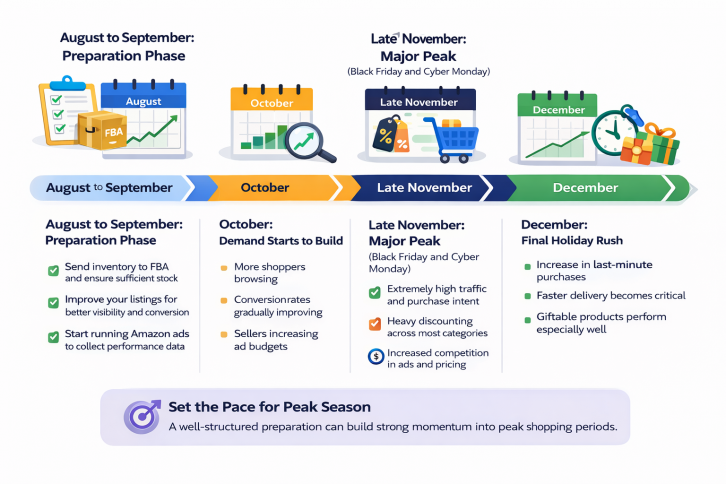
Peak season builds in stages, and each stage requires a different focus.
August to September: Preparation Phase
This is when you set the foundation for peak season.
- Send inventory to FBA and ensure sufficient stock
- Improve your listings for better visibility and conversion
- Start running Amazon ads to collect performance data
October: Demand Starts to Build
You will begin to see steady growth in traffic.
- More shoppers browsing
- Conversion rates gradually improving
- Sellers increasing ad budgets
Many brands begin scaling campaigns during this period to start building momentum before peak season arrives.
Late November: Major Peak (Black Friday and Cyber Monday)
This is the busiest shopping window of the year.
- Extremely high traffic and purchase intent
- Heavy discounting across most categories
- Increased competition in ads and pricing
According to Brandwoven, in 2025, Black Friday reached $11.8 billion in U.S. online sales, while Cyber Monday exceeded $14 billion, making it the largest online shopping day of the year.
At the same time, Tinuiti reports that advertising competition increases significantly. Amazon ad-driven sales during this period have shown 22% to 28% growth across the Cyber Five window, reflecting how aggressively brands invest in visibility.
December: Final Holiday Rush
Shopping becomes more urgent as the holidays approach.
- Increase in last-minute purchases
- Faster delivery becomes critical
- Giftable products perform especially well
This period rewards sellers who have strong inventory planning and fast fulfillment options.
The Four Biggest Amazon Sales Events You Can’t Miss
Prime Day
Prime Day is one of Amazon’s largest sales events outside Q4. The official date for Prime Day in 2026 has not yet been announced by Amazon which normally happens in July but this year it may be moved to June, but stay tuned as we update you with the latest details as soon as they are available.
- Creates a short but intense increase in traffic and sales
- Helps sellers test pricing, listings, and ad strategies
- Provides insight into what may perform well later in the year
Adobe Analytics showed that Prime Day 2025 generated over $24 billion in online spending from July 8 to July 11, indicating a 30% YoY increase across all retailers, highlighting its importance as a mid-year opportunity.
Black Friday
Black Friday marks the beginning of peak holiday shopping. This year, it is expected to celebrate it on November 27, 2026.
- High-intent shoppers actively looking for deals
- Strong conversion rates across categories
- Increased Buy Box competition
Cyber Monday
Cyber Monday continues the momentum, and it would fall on November 30th, 2026.
- Often the largest online shopping day of the year
- Strong performance in digital-first categories
- Continued pressure on ad costs and competition
Holiday Shopping (November-December)
The final stretch lasts throughout the last few months of the year and peaks around Thanksgiving through to Christmas and even post-holiday sales.
- Last-minute purchases increase
- Fast shipping becomes a key decision factor
- Buyers are more focused on delivery and availability
What Changes During Amazon Peak Season
During Amazon peak season, shopper behavior changes and sellers need to adapt quickly.
More customers are actively browsing and buying, often with clear intent tied to holidays or major sales. This leads to higher conversion rates, since shoppers are ready to purchase rather than compare. Decisions also happen faster, so your listings, pricing, and availability need to stay competitive at all times.
Competition also increases. More sellers are competing for the Buy Box, and prices change more frequently. Inventory moves faster too, creating more sales opportunities but also a higher risk of stockouts if not managed carefully.
Advertising costs rise as well. With more sellers bidding for visibility, Amazon PPC becomes more expensive. According to Sellerlabs, CPCs can increase significantly during peak periods, up to 25% year-over-year increases in ad costs during major events like Black Friday and Cyber Monday.
How Peak Seasons Vary Across Regions
In Western markets, demand is mostly spikes during Q4. U.S. shoppers spent $14.25B during Black Friday–Cyber Monday 2025, with Amazon capturing a significant share of Cyber Week, contributing to roughly $11.8B in sales. Success here depends on maximizing a 4–7-day window.
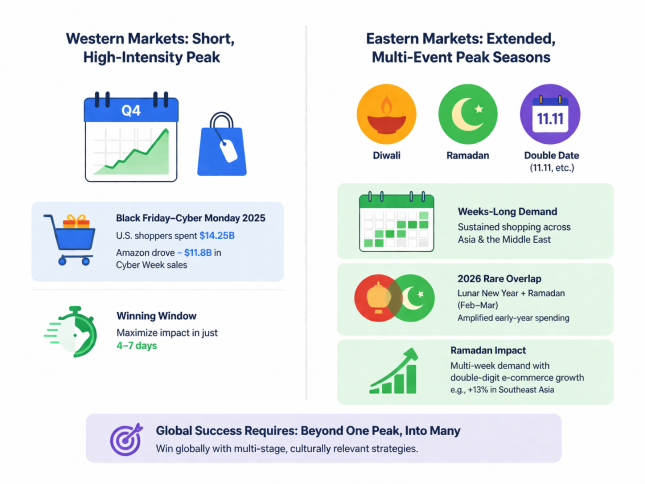
In contrast, Eastern markets run on extended, multi-event peak seasons. Events like Diwali, Ramadan, and “Double Date” campaigns (e.g., 11.11) create sustained, weeks-long demand across Asia and the Middle East.
In 2026, a rare overlap of Lunar New Year and Ramadan (Feb–Mar) is expected to amplify early-year spending by combining two major cultural shopping cycles. Ramadan alone drives multi-week demand and double-digit e-commerce growth (e.g., +13% in Southeast Asia), particularly in fashion and gifting, while Lunar New Year contributes to regional shopping peaks.
Winning global customers requires moving beyond a single peak season to multi-stage, culturally driven strategies.
Regional Peak Season Comparisons (2026)
| Western (US/EU) | Eastern (IN/JP/ME/SEA) | |
|---|---|---|
| Duration | 4-7 day spike | 2-4+ week waves |
| Peak Seasons | Black Friday Cyber Monday /Christmas | Diwali, Ramadan, New Year, and Double-digit Dates |
| 2026 Trends | Q4 concentrated | Lunar New Year + Ramadan overlap (Feb-Mar) |
| Popular Product Categories | Tech, toys, gifts | Fashion, gifting, gold, “Lucky bags” |
How to Prepare for Amazon Peak Season
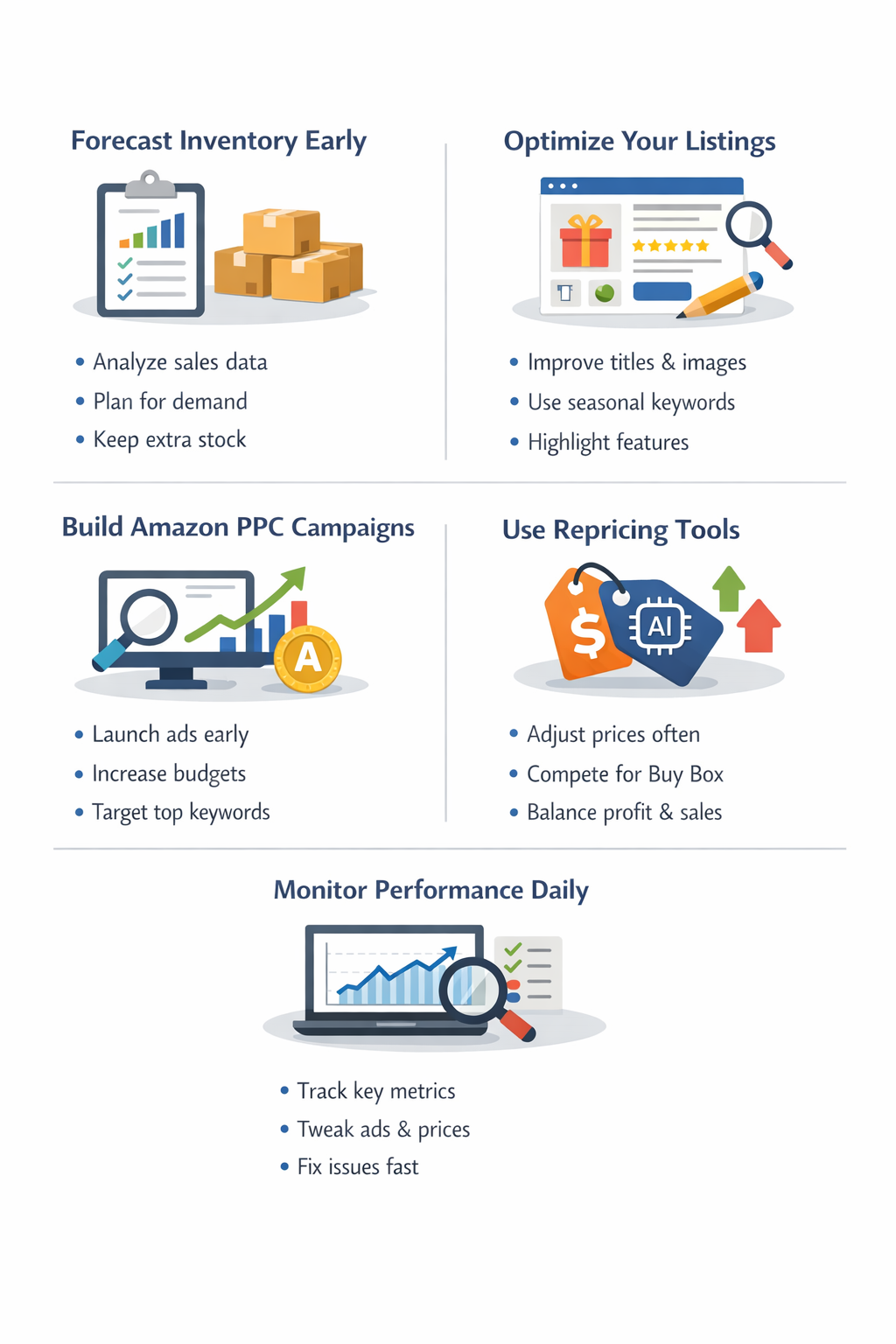
1. Forecast Inventory Early
- Review past sales data
- Plan for increased demand
- Keep extra stock to avoid stockouts
Running out of stock during peak season can lead to lost sales and lower rankings, making inventory planning critical.
2. Optimize Your Listings
- Improve titles, images, and descriptions
- Use seasonal keywords
- Highlight features like giftability
Even small improvements in conversion rate can have a significant impact when traffic increases.
3. Build and Scale Amazon PPC Campaigns
- Start campaigns early to gather data
- Increase budgets gradually
- Focus on high-performing keywords
Without early data, it becomes harder to scale efficiently when competition starts to increase.
4. Use Repricing to Stay Competitive
- Adjust prices regularly to compete for the Buy Box
- Avoid relying only on manual updates
- Balance price competitiveness with profit margins
Pricing becomes more dynamic during peak season, so responsiveness is important. Using an AI-powered repricer can help you shed some manual workload to focus more on other aspects of your business.
5. Monitor Performance Daily
- Track key metrics like conversion rate and return on ad spend (ROAS)
- Adjust pricing and ads based on results
- Resolve issues quickly
Amazon Peak Season Calendar & What Sellers Should Focus On
| Calendar Month | Peak Period | Focus On |
|---|---|---|
| July | Prime Day | Testing strategy |
| October | Demand builds | Scaling ads |
| November | Peak sales | Aggressive pricing + Amazon Ads |
| December | Last-minute buying | Conversion + fulfillment |
FAQs
What months are seasonal at Amazon?
Amazon’s most seasonal period runs from October through December, when holiday shopping drives the highest traffic and sales. However, sellers also see shorter demand spikes throughout the year, especially during events like Prime Day in July and Prime Big Deal Days in October.
Is peak season coming up for Amazon?
If you are approaching Q4, then yes. Amazon peak season typically begins building in October and intensifies through November and December. For sellers, preparation should start earlier, usually in August or September, to be ready for increased demand.
What is the best month to sell on Amazon?
November is usually the strongest month for most sellers, driven by Black Friday and Cyber Monday. That said, performance depends on your category. December can outperform November for giftable products, while Prime Day in July can be a major opportunity to test and scale.
Which is Amazon’s biggest sale of the year?
Black Friday and Cyber Monday are typically the biggest sales events on Amazon, generating the highest traffic and conversion rates across most categories. Prime Day is also one of the largest events, but it tends to be shorter and more concentrated.
How should sellers get ready for peak season?
Preparation should start well before Q4. Focus on sending inventory early, optimizing listings, and building data in your Amazon PPC campaigns. Many sellers also refine pricing strategies in advance so they can stay competitive in the Buy Box while protecting margins during high-demand periods.
The post When Is Amazon Peak Season? Key Dates in 2026 appeared first on BQool Blog.
The upcoming 2026 Amazon Seller Summit
Has anyone registered for the seller to be held May 20 in Anaheim California? Is it worth it? Is it expensive? Is it a high-barrier event, or affordable for tiny bootstrapped just starting their journey on Amazon looking to scale up?
submitted by /u/NachStromm
[link] [comments]
The upcoming 2026 Amazon Seller Summit
Has anyone registered for the seller to be held May 20 in Anaheim California? Is it worth it? Is it expensive? Is it a high-barrier event, or affordable for tiny bootstrapped just starting their journey on Amazon looking to scale up?
submitted by /u/NachStromm
[link] [comments]
How to stop selling without closing my account
Is there a way to shut down all your AZ store sales (FBM and FBA) for couple of months without closing the account? I dont want to remove any of my FBA inventory and I will obviously still pay my monthly Amazon pro seller fee – I just dont want to sell anything for couple of months.
submitted by /u/sbaeidlloan
[link] [comments]
How to stop selling without closing my account
Is there a way to shut down all your AZ store sales (FBM and FBA) for couple of months without closing the account? I dont want to remove any of my FBA inventory and I will obviously still pay my monthly Amazon pro seller fee – I just dont want to sell anything for couple of months.
submitted by /u/sbaeidlloan
[link] [comments]
My experience selling in Japan
Hello
I’m selling on Amazon Japan and I found out that the competition is not that different from USA but the margin is so slow and most of the times I’m break even Acos as most of the sellers are Chinese and put their prices so cheap. and most of Japanese customers just leave bad ratin. I feel overwhelmed as I thought it’s better to sell in Japan as I’m living here . What’s your experience?
submitted by /u/Background_Frosting1
[link] [comments]
My experience selling in Japan
Hello
I’m selling on Amazon Japan and I found out that the competition is not that different from USA but the margin is so slow and most of the times I’m break even Acos as most of the sellers are Chinese and put their prices so cheap. and most of Japanese customers just leave bad ratin. I feel overwhelmed as I thought it’s better to sell in Japan as I’m living here . What’s your experience?
submitted by /u/Background_Frosting1
[link] [comments]
Are there ever cases where one can get 100% of their money back with Safe T claims?
I was just reading someone’s experience with wanting to quit selling on Amazon due to the fraudulent environment/ lack of seller support and it really resonated for me. I had another case of clear cut buyer fraud: they bought 4 items totaling over $400 and filed a refund claiming they didn’t receive the order.
This is where my frustration begins: its so obvious through tracking that they DID receive the package: it was delivered to a parcel locker so its not like they can claim that it disappeared from their front door. The fact that they dish out refunds so easily and lazily without even checking the most basic details is mind blowing.
Then once I filed the Safe-T claim with clear evidence/ screenshots of the delivered package, along with proof that I tried to email the customer but they blocked communications, I guess one could say Im lucky I even got any refund at all.
But this is the second time its happened and each time I get something like 75% of my money back. Where does the rest of it go?
Why does the seller get punished for the buyer’s fraudulent behavior?
This same buyer immediately ordered another product right after filing the refund, which should have also been another red flag to Amazon: why would they order another product from the same seller if they allegedly didn’t receive the original order? I canceled this order because I refuse to do business with scammers and thieves, but now I also worry about retaliation.
Seller support/ account help support are all completely worthless. They don’t care; you can barely understand wtf they’re even saying, and when following their directions, I still get error messages stating that I filed buyer fraud in the wrong place (and then they just reroute you to the same page with no other options other than speak with another useless account health specialist.)
Sorry for my long rant. Clearly this is extremely aggravating.
submitted by /u/Tricky_Ad_4041
[link] [comments]

